
Most European truck fines happen by mistake — here is what they cost and what stops them
Ask a fleet manager how their company got a fine and the honest answer is rarely “we were cutting corners.” It is more often something like this: a driver’s medical certificate expired quietly on a Tuesday. The dispatcher thought the tachograph download had been done. The manager planned a route through France on a public holiday that nobody had flagged. A cabotage run in the Netherlands went one operation over the legal limit because the counter reset date was in a spreadsheet nobody had open.
FleetIntel ran a questionnaire across European transport operators asking how their most recent significant fine actually occurred. The answers were consistent. Drivers did not set out to violate rules. Managers did not knowingly send trucks into restricted zones. The fines came from the gap between what the team knew and what the team needed to know — a gap that widens every year as EU enforcement expands, more countries coordinate checks, and more road rules change by date, by route, and by vehicle category.
The five human errors that generate most European truck fines
Expired documentation nobody checked. A driver’s medical certificate, CPC card, or tachograph calibration expires. It has been in the same drawer for two years. A ROADPOL inspector reads it in under thirty seconds at a rest area outside Cologne. The fine goes to the company, not just the driver, because the company was responsible for checking.
Tachograph data not downloaded within the required window. EU rules require driver card data downloaded every 28 days, vehicle unit data every 90 days. Miss the window and the gap in the archive looks like potential concealment to a BALM inspector — even if nothing was hidden. BALM now checks 56 days of vehicle unit data at roadside checks across Germany. A gap is treated as a probable violation until proven otherwise.
A traffic ban nobody mapped against the route. Germany’s Sunday ban runs from midnight to 22:00 every week. The summer Saturday ban closes ten specific motorway sections from 07:00 to 20:00 in July and August. France has a different ban calendar. Austria has seasonal restrictions that shift by two hours on May 1. A dispatcher who planned the route correctly last October may be working off memory that is six months out of date. One wrong departure time, one ban violated.
Cabotage counted incorrectly. Three operations in seven days, then a four-day cooling-off period. That is the EU rule. It sounds straightforward. In practice, a fleet running multiple drivers across France or the Netherlands is tracking three separate counters simultaneously, each starting from a different unloading date. One miscounted operation is a cabotage violation. In France, that starts at €15,000.
A country-specific rule the team did not know about. Poland’s SENT system requires pre-registration of certain goods movements. Finland’s new cabotage enforcement law entered force in May 2026 with fines up to €25,000 and vehicle clamping. Italy extended its smart tachograph requirements. Each country adds its own layer on top of EU baseline rules. The team cannot track them all from memory.

What these mistakes actually cost
The fine amounts are not small. They are not the kind of number that gets absorbed quietly into operating costs. They are the kind of number that gets discussed at board level.
| Country | Violation | Fine |
|---|---|---|
| France | Cabotage rule violations | Up to €15,000 + additional sanctions |
| France | Driver return not proven or improperly organised | Up to €4,000 |
| France | Weekly rest in the cabin or improperly organised rest | Up to €3,000 |
| Italy | Cabotage rule violations | €5,000–15,000 + vehicle impoundment |
| Italy | Improper smart tachograph | €866–3,464 + possible licence suspension |
| Germany | Tachograph / smart tachograph violations | €750–30,000 |
| Poland | Cabotage / SENT registration violations | ~€2,800 (PLN 12,000) |
| Netherlands | Driving under professional alcohol limit (0.2 g/l) | Criminal proceedings |
| Finland | Systematic illegal cabotage | Up to €25,000 + vehicle clamping |
FleetIntel costs €299 per month for fleets of up to 100 trucks. One avoided France cabotage violation covers 50 months of the subscription. One avoided German tachograph violation at the upper end covers 100 months. The arithmetic is not subtle.
EU enforcement is accelerating, not stabilising
The environment is not getting easier to navigate. It is getting more systematically enforced.
ROADPOL, the European road policing network, runs three coordinated Truck and Bus enforcement operations per year. The second of 2026 ran in the week of 4–10 May, with simultaneous inspections across all EU member states plus Switzerland, Serbia, and Turkey. The February 2026 operation on the E40 motorway in Belgium found violations in 97 of 168 vehicles checked — a detection rate of 58%. That is not a random sample of cheaters. That is more than half of the trucks on a normal transit motorway.
Cross-border fine collection means the fine follows the truck home. EU Directive 2015/413 requires member states to cooperate on collecting road safety penalties across eight violation categories. A fine issued in France or Germany during a ROADPOL week can be pursued by debt collection in Lithuania, Poland, or Romania. Ignoring a foreign EU fine is not an option — it accumulates administrative costs until it is settled.
From 1 July 2026, the tachograph and driving-time rules that have applied to HGVs will extend to light commercial vehicles between 2.5 and 3.5 tonnes used for international transport or cabotage for hire or reward. Fleets running vans on cross-border routes who have not installed G2V2 tachographs are now operating against a deadline that has already passed. The November 2026 ROADPOL operation will be the first to formally include those vehicles in its enforcement scope.
The tool problem: more systems do not mean fewer fines
The standard industry response to compliance risk is to add another system. A tachograph download tool here. A traffic ban calendar there. A separate portal for checking driving time logs. A spreadsheet for document expiry dates. A messaging thread where someone sometimes posts alerts about country-specific restrictions.
That is not a compliance infrastructure. That is a collection of partially overlapping information sources that requires a dispatcher to mentally synthesise across all of them — correctly, every time — while also managing live dispatch, driver communication, and customer deliveries.
Managing multiple disconnected systems creates administrative burdens and increases the risk of legal fines. The problem is not that fleet managers lack information. It is that the information is not where the decisions get made.
Decisions in a dispatch operation get made on the route map. The vehicle is there. The destination is there. The planned path is there. That is where the enforcement intelligence needs to be — not in a separate tab, not in a weekly email digest, not in a policy document that was last updated in 2024.
What FleetIntel adds to the map your team already uses
FleetIntel works as a Chrome extension that adds a live enforcement intelligence layer on top of the TMS map your team is already using. No IT integration project. No separate login. No migration. It works with LocTracker, Locator, FleetHand, and Fleetmaster today.
Here is what appears on the map, and what each element actually means for your operation.
Control spots — Locations where trucks have historically been stopped more often by police and transport authorities. The marker colour lets a dispatcher assess a location at a glance while planning the route. The question changes from “is there a risk somewhere on this route” to “I can see exactly where the historically active locations are and route accordingly.”
Control probability — A number on each marker showing the likelihood the location is active right now. The system updates every 30 minutes, factoring in time of day, day of week, historical reports, and active ROADPOL campaign dates. A control spot with a high historical risk score but low current probability looks different from one that is showing elevated probability at 14:00 on a Tuesday in May. Your dispatcher sees the difference.
Risk score — A 1–10 historical activity indicator. A location might show low current probability at 09:00 but carry a risk score of 8 because it has been consistently active over two years of reports. That matters for route planning the day before a run, not just the hour before.
Latest alerts — Real-time reports on active controls, roadworks, restrictions, strikes, and incidents on route. Not a static traffic layer. Actual dispatched information: a control is running at a specific location now, a strike has been called at a border crossing, a section of motorway is closed. This is the alert that reaches your dispatcher before it reaches your driver.
How the data is collected
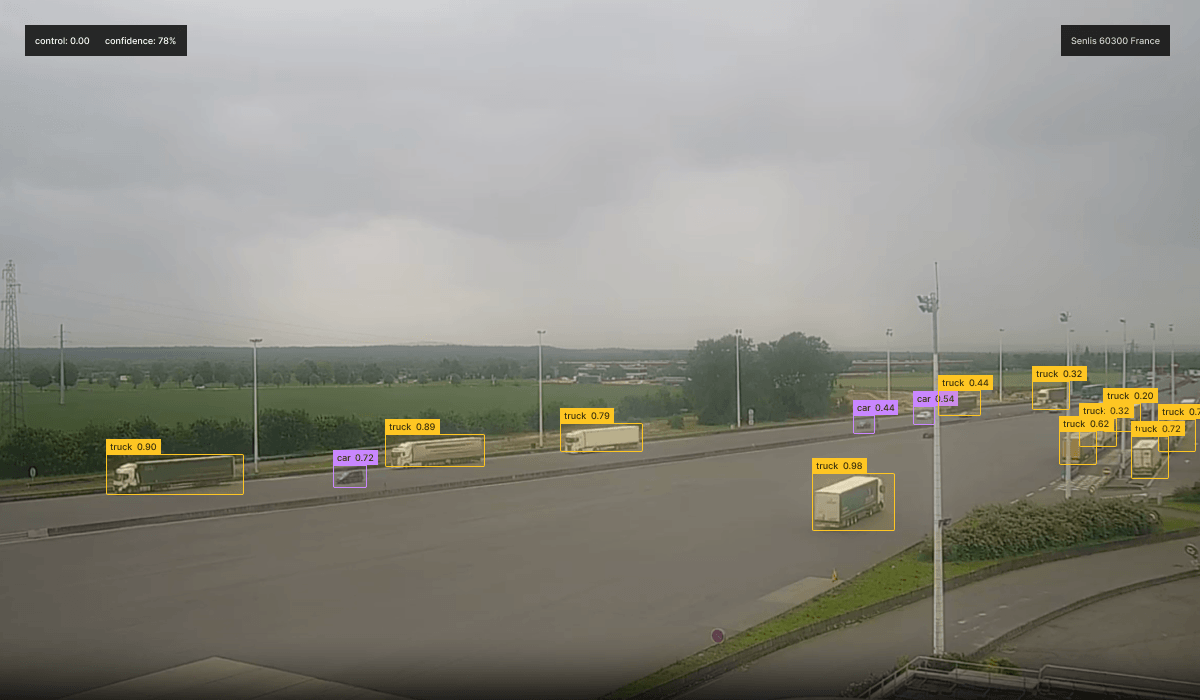
FleetIntel data comes from multiple simultaneous sources: reports from dispatchers and drivers on the platform, closed transport Telegram channels monitored for relevant alerts, Waze signals cross-referenced against route locations, and a computer-vision system monitoring public cameras in key enforcement areas. When multiple independent sources point to the same location at the same time, the confidence score rises. What appears on your map is a triangulated signal, not a single unverified report.
The 14-day question
FleetIntel offers a 14-day free trial — no card required. The relevant question is not whether you can afford €299 per month. The relevant question is whether your team, on its current tools, can reliably avoid the kind of mistakes that generate €3,000, €4,000, or €15,000 fines. If the answer involves any uncertainty at all, the trial costs nothing to find out.
ROADPOL’s May 2026 operation is running this week. The LCV tachograph deadline is 1 July 2026. Cross-border enforcement is already operational across EU member states. The window to operate without route-level enforcement intelligence is not open indefinitely.
Start your 14-day free trial — no card required →
Frequently asked questions
Does FleetIntel require IT integration with our transport management system?
No. FleetIntel works as a Chrome extension and adds a risk intelligence layer on top of supported TMS maps — LocTracker, Locator, FleetHand, and Fleetmaster. It is not a separate IT integration project and requires no involvement from your IT team to deploy.
How is control probability different from a static control spot map?
Static maps show where controls have happened. Control probability shows whether a specific location is likely to be active right now, updated every 30 minutes based on time of day, day of week, historical patterns, and live ROADPOL campaign activity. A location that has been active in the past may not be active today; one that has not appeared before might be elevated based on current signals.
Does FleetIntel guarantee we will avoid all fines?
No. FleetIntel does not remove the operator’s responsibility for following road rules and maintaining correct documentation. The extension helps your team identify risky locations, see live alerts, and make better-informed decisions faster — before problems reach the driver. Responsibility for compliance remains with the operator.
How much does FleetIntel cost after the trial?
€299 per month for fleets of up to 100 trucks. For fleets of 101–500 trucks, the price is €3 per truck per month. For more than 500 trucks, contact FleetIntel for a custom offer. The subscription covers all team members — pricing is calculated by truck count, not by number of users or computers.
What happens to enforcement rules from July 2026?
From 1 July 2026, EU tachograph and driving-time rules extend to light commercial vehicles between 2.5 and 3.5 tonnes used for international goods transport or cabotage for hire or reward. These vehicles will need to carry G2V2 second-generation smart tachographs and will be subject to the same driving and rest-time enforcement that applies to HGVs. The November 2026 ROADPOL Truck and Bus operation will be the first enforcement week in which those vehicles are formally in scope.
Austria: Salzburg bans transit traffic from A10 Tauernautobahn exits from Pentecost through summer 2026
The province of Salzburg has introduced a comprehensive package of exit bans on the A10 Tauernautobahn motorway and transit restrictions on surrounding local roads. The regulations are the most extensive anti-bypass measures introduced in the Salzburg region in recent years. Drivers transiting through Austria to Italy, Slovenia, or Croatia are required to remain on the motorway on the restricted dates — exits are permitted only for traffic with a genuine final destination inside Austria.
The measures are a direct response to a long-running problem. The A10 is one of Austria’s most congested motorways during holiday weekends. In June 2025, a 25-kilometre traffic jam built up near Golling during the Pentecost weekend. Rather than wait out the delay, significant numbers of drivers — particularly those with foreign registration plates — were exiting at motorway junctions to thread through local villages. The Salzburg state government has now made that impossible on the dates when it happens most.
Dates when exit bans are in force
The bans apply around the clock — 00:00 to 24:00 — on the following dates:
| Period | Dates | Reason |
|---|---|---|
| Pentecost weekend | 22–25 May 2026 | Peak holiday travel |
| Brenner demonstration day | 30 May 2026 | Expected A10 diversion from Brenner disruption |
| Summer holidays | 11 July – 13 September 2026 | Peak summer travel season |
The 30 May date is specifically linked to a planned demonstration at the Brenner Pass. If that protest disrupts northbound A13 Brenner traffic, vehicles may be diverted to the A10 — creating precisely the congestion spill that the exit bans are designed to prevent from flowing into local roads.
Which A10 exits are banned
Exit bans cover the entire stretch between Puch-Urstein (Exit 11) and Zederhaus, in both directions. The specific junctions are:
| Exit number | Location | Road affected |
|---|---|---|
| Exit 11 | Puch-Urstein | Both directions — Urstein Süd and Nord roundabouts |
| Exit 16 | Hallein | L107 |
| Exit 22 | Kuchl | B159 |
| Exit 28 | Golling-Abtenau | B159 |
| Exit 43 | Werfen | B159 |
| Exit 44 | Pfarrwerfen-Werfen | L229 |
| Exit 46 | Pongau | L276 |
| Exit 56 | Lammertal-Hüttau | B166 |
| Exit 60 | Eben im Pongau | B99 |
| Exit 63 | Altenmarkt | B320 |
| Exit 66 | Flachau | L230 |
| Exit 74 | Flachauwinkl | Municipal roads |
| – | Zederhaus | L212 |
In addition, the service areas at Landzeit Gasthof Nord and Gasthof Süd are included: vehicles may not leave these rest areas onto municipal roads in the Gasthofsiedlung and Gewerbegebiet Gasthof Süd zones. This specifically targets the practice of using service area exits as a bypass point during stationary motorway queues.
Local road restrictions in surrounding municipalities
Beyond the motorway, the province has also introduced restrictions on specific local and regional roads in five municipalities adjacent to the A10 corridor. These are separate regulations enforced at the district level, aimed at preventing transit traffic entering from the north before reaching the A10.
In Anif: B159 Salzachtal Straße, Ahornstraße, Neu-Anifer Straße, Kirchenstraße, Schloss-Lasseregg-Straße.
In Elsbethen: L105 Halleiner Landesstraße.
In Grödig: Neue-Heimat-Straße, Moosstraße, Gutrathbergweg, L104 Grödiger Landesstraße, L237 Glanegger Landesstraße, B160 Berchtesgadener Straße at the Hangendenstein border crossing.
In Großgmain: L237 Glanegger Landesstraße, L114 Großgmainer Landesstraße at the border.
In Wals-Siezenheim: Viehhauser Straße, Lagerhausstraße, Edelweißstraße, Schulstraße, Grödigerweg, Josef-Hauthaler-Straße, B1 Wiener Straße.
Who is exempt
The exemption applies exclusively to destination traffic to Austria — meaning drivers whose final travel destination is genuinely inside Austrian territory. A hotel booking in Salzburg, a business appointment, or visiting relatives qualifies. Stopping in Austria and then continuing south does not.
The regulations explicitly state that bypassing a traffic jam is not a valid reason to exit. The enforcement sign combination is “no entry” with a supplementary plate reading “ausgenommen Zielverkehr Österreich” (except destination traffic Austria). Police can check at any exit ramp when traffic conditions warrant it, supported by ASFINAG traffic managers and private security personnel.
Local traffic specified in the individual municipal regulations is also exempt, as are cyclists.
Why the A10 generates these restrictions
The A10 runs 192 kilometres from Salzburg south to Villach in Carinthia, crossing the main Alpine divide. It carries the bulk of the tourist and freight traffic moving between Germany, Austria, and the Adriatic coast — Italy, Slovenia, and Croatia. The route includes both the Tauern Tunnel and the Katschberg Tunnel. Despite both tunnels now running two bores since 2011, summer weekend congestion at peak periods can still reach 20–30 kilometres, with waiting times of four to five hours on the worst days.
When traffic queues form, drivers with foreign plates have historically exited to use local roads through the Salzburg–Pongau valley communities. These are narrow village roads with no capacity for transit volumes. The province has tried graduated responses since 2019; the 2026 package is the most comprehensive to date, adding the 30 May Brenner demonstration date to the existing Pentecost and summer calendar.
What this means for freight operators
Trucks are not the primary target of the restrictions — the focus is on private tourist traffic. However, commercial vehicles transiting to Italy, Slovenia, or Croatia via the A10 corridor are subject to the same exit bans. A truck driver who exits at Golling or Werfen during the restricted period to seek an alternative route will be turned back. The only legal option is to remain on the A10 or plan an entirely different corridor — for example, routing via Munich and the Brenner (A13), or via the Inntal (A12) and the Reschen Pass for westbound Italy approaches.
Freight operators planning summer shipments through the Salzburg corridor should note that the summer holiday ban (11 July – 13 September) runs around the clock, seven days a week, for nine weeks. That is not a weekend restriction — it is a continuous 24-hour prohibition on exit for transit traffic throughout the entire peak summer period.
Frequently asked questions
When exactly are the A10 exit bans in force in 2026?
Three periods: 22–25 May (Pentecost weekend), 30 May (Brenner demonstration day), and 11 July – 13 September (summer holidays). All three periods run 00:00–24:00. The summer holiday ban is continuous — it applies every day from 11 July through 13 September, not only on weekends.
Can a truck driver exit the A10 to rest or fuel up?
Service area facilities on the A10 itself are accessible. The ban prohibits exiting onto local roads adjoining the motorway. The Landzeit Gasthof Nord and Gasthof Süd service areas are included in the ban specifically — vehicles may not use those service area exits to enter municipal roads in the surrounding settlement zones.
What happens if a driver exits anyway?
Police enforce the bans using “no entry” signs combined with the supplementary plate “ausgenommen Zielverkehr Österreich.” Officers can check at any prohibited exit. If a driver exits and cannot demonstrate a genuine Austrian destination, they will be turned back. Violations are subject to Austrian traffic fines.
Why is 30 May specifically included?
A demonstration is planned at the Brenner Pass on 30 May 2026. Protests at the Brenner historically divert significant northbound traffic from the A13 to the A10. The Salzburg authorities have proactively included 30 May to prevent that diverted volume from then creating bypass traffic on local roads alongside the A10.
Are the local road bans in Anif, Grödig and surrounding municipalities the same dates?
Yes. The municipal road restrictions in Anif, Elsbethen, Grödig, Großgmain, and Wals-Siezenheim apply on the same dates as the motorway exit bans. They are separate regulations issued by the district authority of Salzburg-Umgebung and the city of Salzburg magistrate, but coordinated to cover the same periods and create a continuous barrier against bypass traffic entering from the north.
Truck driving restrictions across Europe: 30 April – 3 May 2026
The Labour Day long weekend creates one of the most restricted road periods in Europe each year. Between Thursday 30 April and Sunday 3 May 2026, trucks over 7.5 tonnes face driving bans across more than a dozen countries. Austria and Switzerland apply restrictions from 3.5 tonnes. With Labour Day on Friday 1 May being a public holiday across most of Europe, Friday and Sunday carry the widest simultaneous ban windows of the period. Below is a day-by-day breakdown with all country-specific times.
Thursday 30 April 2026
| Country | Hours | Notes |
|---|---|---|
| France | 22:00–24:00 | |
| Hungary | 22:00–24:00 | |
| Poland | 18:00–22:00 | |
| Switzerland | 00:00–05:00 and 22:00–24:00 | From 3.5t |
| Luxembourg | 21:30–24:00 | |
| Bulgaria | 15:00–20:00 | Trakia, Hemus and Struma motorways only. Exempt: entry direction from Sofia |
Friday 1 May 2026 — Labour Day
Labour Day is a public holiday across most of Europe. The ban window is at its widest on this day.
| Country | Hours | Notes |
|---|---|---|
| Austria | 00:00–22:00 | From 3.5t |
| Germany | 00:00–22:00 | |
| France | 00:00–22:00 | |
| Hungary | 00:00–22:00 | |
| Italy | 09:00–22:00 | |
| Slovakia | 00:00–22:00 | |
| Slovenia | 08:00–22:00 | |
| Czech Republic | 13:00–22:00 | |
| Poland | 08:00–22:00 | |
| Switzerland | 00:00–05:00 and 22:00–24:00 | From 3.5t |
| Luxembourg | 00:00–21:45 | |
| Bulgaria | 09:00–14:00 | Trakia, Hemus and Struma motorways only. Exempt: entry direction from Sofia |
Saturday 2 May 2026
| Country | Hours | Notes |
|---|---|---|
| Austria | 15:00–24:00 | From 3.5t |
| France | 22:00–24:00 | |
| Hungary | 22:00–24:00 | |
| Slovenia | 08:00–22:00 | |
| Poland | 18:00–22:00 | |
| Switzerland | 00:00–05:00 and 22:00–24:00 | From 3.5t |
| Luxembourg | 21:30–24:00 |
Sunday 3 May 2026
Sunday carries the standard weekly bans alongside the Labour Day weekend return traffic.
| Country | Hours | Notes |
|---|---|---|
| Austria | 00:00–22:00 | From 3.5t |
| Germany | 00:00–22:00 | |
| France | 00:00–22:00 | |
| Hungary | 00:00–22:00 | |
| Italy | 09:00–22:00 | |
| Slovakia | 00:00–22:00 | |
| Slovenia | 08:00–22:00 | |
| Czech Republic | 13:00–22:00 | |
| Poland | 08:00–22:00 | |
| Switzerland | 00:00–24:00 | From 3.5t — full day |
| Luxembourg | 00:00–21:45 | |
| Bulgaria | 12:00–20:00 | Trakia, Hemus and Struma motorways only. Exempt: exit direction from Sofia |
Hungary: additional routing rules
Trucks over 7.5 tonnes travelling from Hungary toward Romania are prohibited from using National Road 42 and must use the M4 motorway. From 1 January 2026, foreign trucks over 20 tonnes transiting Hungary must travel exclusively on motorways and express roads — secondary roads are not permitted.
Romania: specific road restrictions 30 April – 1 May
Romania applies targeted restrictions on specific roads during the Labour Day weekend, on top of the permanent DN1 restrictions.
| Road | Section | Date | Hours |
|---|---|---|---|
| A2 | Bucharest – Constanța (incl. A2/DNCB and A2/A4 junctions), both directions | 30 April | 16:00–22:00 |
| A2 | Same section | 1 May | 06:00–22:00 |
| DN7 | Pitești – Râmnicu Vâlcea – Veștem (DN7/DN7C to DN7/DN1 junctions), both directions | 30 April | 18:00–22:00 |
| DN7 | Same section | 1 May | 06:00–22:00 |
| DN39 | Agigea – Mangalia (DN39/DN39A junction to Mangalia city limits), both directions | 30 April | 16:00–22:00 |
| DN39 | Same section | 1 May | 06:00–22:00 |
Romania: permanent DN1 restrictions (year-round)
| Section | Days | Hours |
|---|---|---|
| DN1 km 17+900 (Otopeni) – Ploiești (DN1/DN1A junction) | Mon–Thu | 06:00–22:00 |
| DN1 km 17+900 (Otopeni) – Ploiești (DN1/DN1A junction) | Fri–Sun | 00:00–24:00 |
| DN1 km 67+400 Ploiești – Brașov (DN1/DN1A junction) | Mon–Thu | 06:00–22:00 |
| DN1 km 67+400 Ploiești – Brașov (DN1/DN1A junction) | Fri–Sat | 00:00–01:00 and 05:00–24:00 |
| DN1 km 67+400 Ploiești – Brașov (DN1/DN1A junction) | Sun | 00:00–24:00 |
Additionally, the DN7 Olt Valley seasonal restriction (Râmnicu Vâlcea – Veștem) applies Monday to Saturday 08:00–17:30 from 16 March to 15 June 2026 for vehicles over 7.5 tonnes.
Public holidays 30 April – 3 May 2026
| Date | Countries observing a public holiday |
|---|---|
| Friday 1 May | Albania, Andorra, Armenia, Austria, Belarus, Belgium, Bulgaria, Cyprus, Czech Republic, Croatia, Estonia, Finland, France, Germany, Gibraltar, Greece, Iceland, Italy, Latvia, Liechtenstein, Lithuania, Luxembourg, North Macedonia, Malta, Moldova, Montenegro, Norway, Poland, Portugal, Romania, Russia, Serbia, Slovakia, Slovenia, Spain, Sweden, Turkey, Ukraine, Hungary |
| Saturday 2 May | Montenegro, Russia, Serbia, Slovenia, Spain (Madrid region) |
| Sunday 3 May | Lithuania, Poland, Russia |
Frequently asked questions
Which countries have the widest truck bans on 1 May 2026?
Austria, Germany, France, Hungary, Slovakia, and Luxembourg all apply bans from 00:00 to 22:00 on 1 May. Italy applies 09:00–22:00. Poland and Slovenia apply 08:00–22:00. Czech Republic applies 13:00–22:00. Switzerland applies its standard 00:00–05:00 and 22:00–24:00 windows, from 3.5 tonnes.
Does Germany have restrictions on Thursday 30 April or Saturday 2 May?
No. Germany’s standard Sunday ban applies on 3 May (00:00–22:00) and the Labour Day ban applies on 1 May (00:00–22:00). There are no restrictions on 30 April or 2 May under the standard German framework, unless a state-level event applies locally.
What is the Bulgarian restriction and who is exempt?
Bulgaria applies restrictions on the Trakia, Hemus, and Struma motorways only — not the full national road network. On 30 April and 1 May the restriction runs 15:00–20:00 and 09:00–14:00 respectively, with an exemption for traffic entering in the direction from Sofia. On 3 May (12:00–20:00) the exemption applies to traffic exiting toward Sofia.
Why does Switzerland apply restrictions from 3.5 tonnes?
Switzerland is not an EU member state and applies its own transit road rules. Restrictions on Swiss roads apply to all goods vehicles from 3.5 tonnes gross vehicle weight — a lower threshold than most EU countries, which start at 7.5 tonnes. This affects a wider range of commercial vehicles including larger delivery vans.
ROADPOL truck checks across Europe start 4 May 2026 — what fleets need to know
ROADPOL, the European road policing network, launches its second coordinated Truck and Bus enforcement operation of 2026 on Monday 4 May, running through Sunday 10 May. Officers across all EU member states, together with Switzerland, Serbia, and Turkey, will run simultaneous roadside inspections targeting heavy goods vehicles and buses. The operation is not a routine check week. ROADPOL’s February 2026 campaign on the E40 motorway in Wetteren, Belgium, produced 97 detected offences from just 168 vehicles inspected — a detection rate of nearly 58%. Operators who assume their vehicles will pass without incident should look at that number again.
The May operation is the second of three Truck and Bus control weeks scheduled for 2026, following the February campaign and ahead of a further operation planned for 16–22 November. Officers will target unsafe practices such as overloading, violations of driving and rest time regulations, and technical defects that compromise safety. The scale of checks is determined nationally, meaning intensity varies by country — but in major transit nations including Germany, Poland, France, Austria, and the Netherlands, enforcement will be visibly heightened during the week.
Where checks take place
Controls will be conducted not only on motorways and major roads but also in rest areas, ports, border crossings, and logistics hubs — locations where long-distance and cross-border transport is most concentrated. This is an important operational detail. Drivers who assume checks only happen at designated roadside inspection bays are wrong. A truck parked at a motorway rest area during the ROADPOL week is as likely to be approached as one moving on the road.
In February and November operations, inspections are conducted jointly with the European Labour Authority, which focuses specifically on labour compliance — posting of workers, employment documentation, and minimum wage obligations. The May operation is primarily road safety focused, but national labour enforcement agencies may conduct parallel checks at their own discretion.
What officers check
The inspection scope covers six main areas. Technical condition of the vehicle: brakes, lights, tyres, steering, and trailer coupling. Dimensions and weight: axle loads and total gross weight, checked against the vehicle’s technical documents and the applicable national limits. Driving and rest times: tachograph data is read at the roadside, covering the current day and typically the previous 28 days on the driver card — since 31 December 2024 the data retention requirement has extended to 56 days on the vehicle unit. Tachograph integrity: the device itself is checked for calibration validity, missing seals, or evidence of manipulation. Cargo and load securing: the load must be properly restrained and the weight distribution must comply with axle limits. Documentation: Community licence, driver attestation, CPC certificate, CMR documents, and vehicle roadworthiness certificate must all be present in the cab and accessible.
The most common infringements detected across previous ROADPOL operations include violations of driving and rest time regulations, tachograph-related offences ranging from digital manipulation and driving without a driver card to calibration irregularities, illegal cabotage operations, missing or incomplete transport documents, and cases of illegal employment.
What the February 2026 results show
The E40 Wetteren operation in Belgium during the February 2026 Truck and Bus week involved Belgian authorities, Dutch police, and European Labour Authority agents working together. Of 168 vehicles checked, 97 offences were detected. That is one vehicle in every 1.7 checked. The result is consistent with the pattern from earlier years: during the February 2024 operation across 29 countries, 248,498 trucks were inspected and 86,830 violations were found — on 2,467 occasions onward travel was prohibited until the condition of the truck or load had been restored. Nearly one in every three trucks checked in 2024 had at least one recordable violation. The May 2026 operation runs on the same framework.
What happens if an offence is detected
The outcome depends on the severity of the infringement and the country where the check takes place. For minor documentation issues — an expired calibration sticker, a missing attestation — the driver typically receives a written warning or a fine and is permitted to continue after the paperwork is noted. For serious violations — overloading beyond national thresholds, driving hours exceeding statutory limits, evidence of tachograph tampering — the vehicle can be immobilised on the spot until the violation is remedied. For overloading, that means unloading part of the cargo before the truck can move. For driving hours violations, it means the driver must take the required rest before continuing. The fine is issued regardless; the journey prohibition is an additional measure on top of it.
Fine amounts vary by country and violation type. Germany’s Bußgeldkatalog imposes separate fines on the driver and the company: a tachograph offence can cost the driver €150–€750 and the company up to €1,500. Italy’s overloading fines start at €418 and reach €1,726 for axle overloads exceeding 10%. In France, driving without a valid CPC card carries €750. The practical point is that the fine does not stay in the country — EU cross-border enforcement mechanisms mean fines issued during the ROADPOL week can be pursued in the operator’s country of registration.
National authorities may continue targeted checks after the coordinated week ends on 10 May. A truck flagged during the ROADPOL operation but not stopped due to resources may be identified in a follow-up check the following week.
The LCV compliance change coming 1 July 2026
The May operation runs alongside preparations for a structural change that affects operators of lighter vehicles. From 1 July 2026, EU rules on driving limits, rest times, and second-generation smart tachographs will apply to light commercial vehicles weighing between 2.5 and 3.5 tonnes used for international goods transport or cabotage for hire or reward. The European Labour Authority confirms these vehicles will require a second-generation smart tachograph — the same G2V2 standard already required for new HGVs — and will fall under the full driving and rest-time regulatory framework.
This means operators currently running 3-tonne vans on international routes who have not yet installed tachographs or briefed drivers on the 4.5-hour maximum continuous driving rule are now working against a two-month deadline. The ROADPOL May operation will not formally include LCVs in its scope — the rules do not yet apply — but by November, when the third Truck and Bus week runs, those vehicles will be in scope for enforcement.
What fleet managers need to do before 4 May
Four specific actions reduce exposure during the enforcement week. First, confirm that tachograph data has been downloaded within the required intervals — 28 days for driver cards, 90 days for vehicle units — and that the archive is complete. An inspector who finds a gap in the data archive treats it as a potential concealment. Second, run axle weight checks before dispatch on any load that is close to legal limits. Roadside scales do not give benefit of the doubt, and the fine is issued at the point of detection regardless of what the loading documents say. Third, confirm that all in-cab documentation is physically present: Community licence copy, driver attestation, CPC card, vehicle inspection certificate, and CMR for the current load. Missing paperwork during a ROADPOL week creates delay even where the violation is minor. Fourth, brief drivers specifically on the 56-day data window now required on vehicle units — a driver who presents only the card data when asked for unit data is creating unnecessary suspicion.
Frequently asked questions
Which countries participate in the ROADPOL Truck and Bus operation in May 2026?
Roadside inspections will be carried out simultaneously in all EU member states, as well as Switzerland, Serbia, and Turkey. The scale and intensity of checks is determined nationally. Countries with high volumes of international transit traffic — Germany, Poland, France, Austria, the Netherlands, Romania, and Belgium — typically see the highest number of checks per week during ROADPOL operations.
What specifically will officers check during the May 2026 operation?
Technical condition, vehicle dimensions and weight, driving and rest-time compliance, tachograph calibration and integrity, cargo securing and load distribution, and documentation. Documentation checks cover the Community licence, driver CPC certificate, driver attestation, CMR waybill, and vehicle roadworthiness certificate. In countries where the European Labour Authority is involved, posting of workers documents may also be checked.
Can a truck be stopped at a rest area during the ROADPOL week, not just on the road?
Yes. ROADPOL operations explicitly include rest areas, ports, border crossings, and logistics hubs as control locations — not only moving traffic on motorways. A stationary vehicle at a motorway services is as accessible to officers as one on the road.
What happens if the vehicle is found overloaded during the check?
The vehicle is prohibited from continuing until the overload is resolved. That typically means unloading part of the cargo at the roadside or at a nearby logistics facility. A fine is issued separately and does not substitute for the journey prohibition. Fine amounts vary by country and degree of overloading: in Germany from €25 upward depending on the percentage excess; in Italy from €418 for axle overloads.
Will LCVs between 2.5 and 3.5 tonnes be inspected during the May 2026 ROADPOL operation?
The May operation focuses on heavy goods vehicles and buses. The EU tachograph and driving-time rules for LCVs between 2.5 and 3.5 tonnes used in international transport do not come into force until 1 July 2026, so those vehicles are not yet formally in scope. However, from 1 July onward, and certainly by the November 2026 ROADPOL operation, those vehicles will be subject to the same tachograph and rest-time checks as HGVs.
Can fines issued in one EU country during the ROADPOL week be collected in another?
Yes. EU Directive 2015/413 on cross-border enforcement requires member states to cooperate on collecting road safety fines for specified violation categories. A fine issued in Belgium or Germany during the ROADPOL week can be pursued in Poland, Romania, or any other EU country where the operator is registered. Administrative costs accumulate if the fine is ignored.
European truck driving bans in May 2026: full calendar by country
May 2026 brings an unusually dense concentration of truck driving bans across Europe, driven by three federal public holidays — Labour Day on May 1, Ascension Day on May 14, and Whit Monday on May 25 — plus Orthodox Ascension on May 28 triggering additional restrictions in Greece. For fleet managers running cross-border freight through central Europe, the Brenner corridor, the Balkans, or the France–Spain axis, the month requires careful calendar checking against every country the route passes through.
May 1 — Labour Day: twelve countries simultaneously
Labour Day is a federal public holiday triggering full-day truck bans in twelve European countries simultaneously.
Austria and Liechtenstein: full 24-hour ban, all roads.
Bulgaria: 09:00–14:00.
Croatia: 14:00–23:00.
Czech Republic: 13:00–22:00 on motorways and category I roads.
Italy: 09:00–22:00.
France, Slovakia, Hungary, Germany: 00:00–22:00.
Greece: 08:00–13:00.
Luxembourg: 00:00–21:45.
Poland and Slovenia: 08:00–22:00.
Romania: 06:00–22:00.
Weekday night bans: every working day throughout May
On all working days in May — covering the weeks of May 4–8, 11–15, 18–22, and 25–29 — Austria, Switzerland, and Liechtenstein maintain their standard weekday night ban for trucks over 7.5 tonnes. The restriction runs from 22:00 to 05:00 and again from 22:00 to 00:00, applying every night regardless of cargo or route.
Key additional weekday dates
May 5–6 (Tuesday–Wednesday): Bulgaria adds a daytime restriction from 15:00 to 20:00.
May 7 (Wednesday): France applies an evening restriction from 22:00 to 00:00. Luxembourg applies from 21:30 to 00:00.
May 8 (Thursday) — VE Day: France and Slovakia observe Victory in Europe Day as a public holiday — ban 00:00–22:00 in both countries. Czech Republic 13:00–22:00. Luxembourg full day 00:00–24:00. Germany does not observe May 8 as a federal holiday.
May 13 (Wednesday): France applies an evening restriction from 22:00 to 00:00. Luxembourg applies from 21:30 to 00:00 toward France, and from 23:30 to 00:00 toward Germany. Austria adds a daytime sectoral restriction from 07:00 to 22:00 — this is an A12/A13 Brenner corridor eve-of-Ascension restriction ahead of the May 14 public holiday.
May 14 (Thursday) — Ascension Day: A public holiday across Austria, Germany, France, Switzerland, and Liechtenstein. Austria: 00:00–22:00 nationwide. Germany: 00:00–22:00 nationwide. France: 00:00–22:00. Luxembourg: 00:00–21:45.
May 22 (Friday): Austria adds a sectoral A12/A13 restriction from 07:00 to 22:00 — the start of the Whit weekend pre-restriction window. Bulgaria adds 15:00–20:00.
May 25 (Monday) — Whit Monday: The third federal public holiday of the month. Austria, Liechtenstein, and Switzerland: full 24-hour ban. France, Hungary, and Germany: 00:00–22:00. Luxembourg: 00:00–21:45. Bulgaria: 12:00–20:00.
May 29 (Thursday): Croatia applies a restriction from 15:00 to 23:00, ahead of Croatian State Day on May 30. Greece applies 16:00–22:00 — this is a bridge-day restriction tied to Orthodox Ascension Day, which falls on May 28 in 2026.
Saturdays in May
Every Saturday throughout May, Austria, Switzerland, and Liechtenstein apply night restrictions: 00:00–05:00 and 22:00–00:00. Luxembourg restricts traffic toward France from 21:30 to 00:00, and toward Germany from 23:30 to 00:00. France and Hungary apply an evening restriction from 22:00 to 00:00.
May 2 (Saturday): Poland adds 18:00–22:00. Slovenia adds 08:00–22:00.
May 23 (Saturday): Austria extends restrictions to 07:00–15:00 in addition to the standard night windows. Bulgaria applies 09:00–14:00. Poland adds 18:00–22:00.
May 30 (Saturday): Austria applies an extended daytime restriction from 07:00 to 00:00 — a full Saturday ban tied to the Orthodox Ascension/Croatian State Day long weekend. Croatia: 14:00–23:00. Greece: 08:00–13:00. Romania: 16:00–22:00. Italy: 09:00–14:00.
Sundays in May
Every Sunday in May the following standard bans apply:
Austria, Liechtenstein, Switzerland: full 24-hour ban.
France, Slovakia, Hungary, Germany: 00:00–22:00.
Czech Republic: 13:00–22:00.
Italy: 09:00–22:00.
Slovenia: 08:00–22:00.
Luxembourg: 00:00–21:45.
May 3 (Sunday): Greece adds 11:00–23:00, tied to the Labour Day return-flow period.
May 24 (Sunday — Whit Sunday): France and Luxembourg apply a full 24-hour ban. Poland adds 08:00–22:00.
May 31 (Sunday): Croatia adds 12:00–23:00. Romania adds 06:00–22:00.
Planning implications for fleet managers
May 2026 has no clean week for Germany–Italy Brenner corridor traffic. The May 1 Labour Day ban hits on Friday, closing the first working day of the month. May 8 closes France and Slovakia. May 14 Ascension Day closes Germany, Austria, France, and Switzerland simultaneously — the three most critical countries for Alpine transit. May 25 Whit Monday closes the same corridor again. That is four prohibited days on the Brenner axis within a single month, plus the additional A12/A13 sectoral bans on May 13 and May 22 that compress the usable windows further.
For Balkan routes, the Croatian State Day on May 30 combined with the Orthodox Ascension bridge day on May 29 and the Greek restrictions creates a three-day disruption window at the end of the month that affects the Slovenia–Croatia–Greece corridor simultaneously.
Loads that cannot be held should be routed before 00:00 on each ban day or scheduled for departure after the ban window closes that evening. For Austria, the night ban between 22:00 and 05:00 means the earliest permitted departure window on any restricted day is 05:00 — not midnight.
Frequently asked questions
Which countries ban trucks on Ascension Day, 14 May 2026?
Austria (00:00–22:00 nationwide), Germany (00:00–22:00), France (00:00–22:00), and Luxembourg (00:00–21:45) all observe Ascension Day as a public holiday with a full truck driving ban. Switzerland and Liechtenstein apply a 24-hour ban. The restriction does not apply in Italy, Spain, the Netherlands, or Poland on this date.
Does the May 8 VE Day truck ban apply in Germany?
No. May 8 is not a federal public holiday in Germany. The VE Day ban applies in France (00:00–22:00), Slovakia (00:00–22:00), Czech Republic (13:00–22:00), and Luxembourg (full day). German trucks are unaffected on May 8, but loads transiting through France or Slovakia on that date will face restrictions.
Why does Austria have an additional restriction on May 13?
May 13 is the Wednesday before Ascension Day (May 14), which is a public holiday in Austria. ASFINAG and the Tyrol regional government publish calendar-based sectoral restrictions on the A12 Inntal and A13 Brenner motorways ahead of major holiday weekends. The May 13 daytime restriction from 07:00 to 22:00 is part of this pre-holiday corridor management, separate from the statutory nationwide ban on May 14 itself.
Why are there Greek truck restrictions on May 29–30?
Orthodox Easter falls on April 19 in 2026, placing Orthodox Ascension Day on May 28 (Thursday). May 29 (Friday) is the bridge day, triggering Greece’s standard outbound traffic restriction from 16:00 to 22:00. May 30 (Saturday) carries the return-flow restriction from 08:00 to 13:00. These restrictions apply to trucks over 3.5 tonnes on Greek motorways and national roads.
What is the alcohol limit for truck drivers in Austria and Germany during these restricted periods?
The alcohol limit is unchanged by driving ban periods. Austria and Germany both apply a 0.5 g/l standard limit, but professional drivers — those operating commercial vehicles as part of their employment — are held to a 0.1 g/l limit in Austria and face stricter consequences than private drivers at 0.5 g/l in Germany. Neither country changes these thresholds on public holidays.
Italy and Netherlands raise truck fines as Europe-wide enforcement tightens in 2026
Italy now has the highest speeding fines in Europe for heavy vehicles. A truck driver caught exceeding the speed limit by more than 60 km/h faces a fine of up to €3,382, and using a handheld mobile phone carries up to €660. These figures come from Italy’s updated Codice della Strada, which came into force in 2024 and reached full enforcement in 2026. Meanwhile, the Netherlands has raised its fines by 3–4% from January 2026, with phone use now costing €440 and red-light violations €320. Neither country allows foreign-registered trucks to quietly ignore the bills. EU cross-border enforcement means the fine follows the vehicle home.
Italy: the toughest penalty schedule in the EU
Italy’s revised road code sets out a steep sliding scale for speeding violations. Exceeding the limit by 10–40 km/h brings a fine of €173–€695 and three penalty points. At 40–60 km/h over, the fine rises to €543–€2,170, six penalty points apply, and the licence is suspended for one to three months. More than 60 km/h over the limit: €845–€3,382, ten penalty points, and a suspension of six to twelve months. For trucks, the starting speed limits are already lower than for passenger cars — 70 km/h on rural roads and 80 km/h on motorways — so the gap to a serious violation is narrower than it looks.
Fines issued between 22:00 and 07:00 carry an automatic 30% surcharge. A first offence paid within five days receives a 30% discount, which disappears entirely once the excess exceeds 40 km/h. The speed camera network is extensive and the tolerance before a camera fires is either 5 km/h or 5% of the limit above 100 km/h, whichever applies.
On alcohol, Italian law applies zero tolerance to professional drivers, including those operating commercial vehicles and heavy goods vehicles. A professional driver with any detectable blood alcohol is subject to a fine of €164, which doubles to €328 if involved in an accident, plus five licence points. Ordinary drivers start being penalised at 0.5 g/l. The gap between the two thresholds matters most on early-morning departures after an evening meal — what reads as normal social drinking the night before can still register on a morning test.
Mobile phone use now starts at €165 and reaches €660, with eight penalty points and a possible licence suspension of 15 days to two months for a first offence. A repeated violation within two years can push that suspension to three months.
Netherlands: automated, precise and increasingly expensive
More than 90% of Dutch speeding fines are issued by fixed cameras, and foreign-registered trucks receive penalties via EU data sharing. Some hauliers report receiving fines before their drivers return from delivery. That is not an exaggeration — the Dutch CJIB processes camera data in near-real time and the penalty notice goes to the registered vehicle owner, not the driver. For a foreign haulage company, that means the fine arrives at the company address within days.
Driving 10 km/h over the speed limit in a built-up area costs €95 in 2026. The same excess on a motorway costs €84. Higher violations escalate steeply. Running a red light is €320. Using a mobile phone in hand is €440. Both increased from 2025 under the annual rounding-up mechanism that adjusts fines to the nearest €10.
The professional driver alcohol limit in the Netherlands is 0.2 g/l — the same threshold applied to novice drivers with fewer than five years of experience. That is half the standard 0.5 g/l limit. A reading between 0.2 and 0.5 g/l is a misdemeanour; above 0.5 g/l becomes a criminal matter. Dutch enforcement uses frequent roadside checks, and the 0.2 g/l limit catches people who would consider themselves well below the standard threshold.
Dutch law uses registration number liability. The vehicle owner is financially responsible for the fine regardless of who was driving. For operators running vehicles under agency arrangements or with owner-driver subcontractors, that distinction matters operationally: the registered owner absorbs the fine first, and recovery from the actual driver is a separate civil matter.
Poland: 15 points for a red light, instant licence confiscation for serious speeding
Running a red light in Poland costs 500 złoty (approximately €115) and carries 15 penalty points. Poland’s reformed penalty point system, introduced between 2022 and 2024, is one of the most aggressive in Europe — 15 points for a single red-light violation leaves a driver with six points of their 24-point limit remaining from a single infraction. Enforcement officers can confiscate driving licences on the spot for major speeding or alcohol offences. Foreign trucks are regularly stopped for overweight checks at ITD transport inspection posts, which operate on major transit routes including the A1, A2, and A4.
Using a phone while driving in Poland carries 500 złoty and 12 penalty points. Speeding by 31–40 km/h costs 800 złoty, rising to 1,600 złoty for a repeat offence within two years. Exceeding the limit by more than 71 km/h brings a fine of 2,500 złoty. At current exchange rates, 2,500 złoty is around €580 — serious money, and accompanied by immediate licence seizure in the more extreme cases.
Germany: the driver-company split and tachograph enforcement
Germany’s Bußgeldkatalog separates liability between the driver and the company that commissioned the transport. A driver caught violating the Sunday ban pays €120; the operator who ordered the run pays €570. The same split applies to other violations: the driver faces a personal fine, and the company faces a regulatory penalty if it tolerated or instructed the violation.
Tachograph offences are where German enforcement hits hardest for international fleets. BALM inspectors can read 56 days of tachograph data at the roadside and cross-reference it against working time logs. Tampering with tachograph data is a criminal offence, not a traffic fine. Missing or expired driver cards, incorrect mode entries, and downloading gaps are all enforceable on the spot. Bavaria and North Rhine-Westphalia operate dedicated HGV lanes at some motorway controls where both speed and overtaking are simultaneously monitored — a violation can generate Flensburg points within minutes of detection.
Cross-border enforcement: the fine follows the truck
EU Directive 2015/413 on cross-border enforcement of road safety offences obligates member states to share vehicle registration data for eight categories of violation: speeding, non-use of a seatbelt, failing to stop at a red light, drink-driving, drug-driving, not wearing a crash helmet, use of a forbidden lane, and use of a mobile device. The Netherlands and Italy both operate automated cameras that generate violation records in real time, match them against the European Vehicle Registration Database (EUCARIS), and send penalty notices cross-border.
Dutch fines of €70 or more can be enforced in Germany and other EU countries through cross-border cooperation agreements. The practical consequence for fleet managers is that a penalty notice from the Italian Polizia Stradale or the Dutch CJIB does not require the driver to be stopped at the roadside. The camera does the work, the database matches the plate, and the invoice arrives at the company address. Ignoring it does not make it go away — unpaid EU fines can be referred to debt collection agencies operating in the country of registration, and the amounts compound with administrative costs.
Alcohol limits for professional drivers by country
The gap between the standard and professional driver alcohol limits varies significantly by country, and it is the professional limit that matters for HGV operators. Italy applies zero tolerance — any detectable amount. The Netherlands sets 0.2 g/l for professional drivers, the same as its novice driver threshold. Germany and France apply the standard 0.5 g/l to professional drivers but enforce it strictly with mobile breath-testing units at motorway rest stops. Spain has tightened its professional limit to 0.3 g/l and has announced plans to move to 0.2 g/l. Poland applies 0.2 g/l as the misdemeanour threshold for professional drivers, with any reading above treated as a criminal offence under the reforming framework.
For fleets operating across multiple countries, the practical approach is the most conservative limit: brief drivers on the Italian zero-tolerance rule for any cross-border trip, and treat 0.2 g/l as the operational working limit regardless of which country the driver is in that morning.
What fleet managers need to do now
Three specific actions matter more than general awareness. First, update driver briefing documentation to include the professional alcohol thresholds by country — not the standard limit, the professional one. Second, confirm that any vehicle registered under the company name in the Netherlands or Italy has a clear process for receiving and processing penalty notices, because those fines arrive at the registered owner’s address automatically. Third, review whether existing subcontractor or agency driver arrangements create ambiguity about who the registered owner is — in the Netherlands especially, registration number liability means the invoice goes to whoever holds the registration, and recovery from the actual driver is the company’s problem to sort out separately.
Frequently asked questions
What is the fine for exceeding the speed limit by more than 60 km/h in Italy?
In Italy, exceeding the speed limit by more than 60 km/h carries a fine of €845 to €3,382, ten penalty points, and a licence suspension of six to twelve months. Trucks have lower base speed limits than passenger cars on Italian roads — 70 km/h on rural roads and 80 km/h on motorways — so the gap to this bracket is narrower than for car drivers. Fines issued at night between 22:00 and 07:00 carry an additional 30% surcharge.
By how much have Dutch traffic fines increased in 2026?
The Netherlands raised most traffic fines by 3–4% from January 2026, rounding amounts up to the nearest €10. A handheld mobile phone fine is now €440 (up from €430 in 2025). Running a red light costs €320, up from €310. Speeding 10 km/h over the limit in a built-up area costs €95. These amounts exclude the €9 administrative processing fee added by the CJIB.
What is the alcohol limit for professional truck drivers in the Netherlands?
The professional driver alcohol limit in the Netherlands is 0.2 g/l, the same threshold that applies to novice drivers with fewer than five years of experience. A reading between 0.2 and 0.5 g/l is processed as a misdemeanour. Above 0.5 g/l becomes a criminal matter. The standard limit for experienced private drivers is 0.5 g/l, so the professional threshold is significantly stricter.
Can a fine from Italy or the Netherlands be enforced in Poland or Germany?
Yes. EU Directive 2015/413 on cross-border enforcement requires member states to share vehicle registration data and cooperate on collecting road safety fines for eight categories of violation including speeding, red lights, drink-driving, mobile phone use, and seatbelt non-compliance. Dutch fines above €70 are enforceable in other EU countries. Italian fines can similarly be referred for cross-border collection. Ignoring a foreign EU fine compounds the amount through administrative costs and debt collection fees.
How does Poland penalise red-light violations for truck drivers?
In Poland, running a red light costs 500 złoty (approximately €115) and adds 15 penalty points to the driver’s licence record. The Polish point system was reformed between 2022 and 2024 and is among the most punitive in the EU — 15 points from a single violation leaves the driver with only nine points remaining before licence revocation. Enforcement officers can confiscate licences on the spot for major offences.
Does the company pay separately from the driver for traffic violations in Germany?
Yes. Germany’s Bußgeldkatalog separates liability between the driver and the company that ordered or permitted the violation. A driver violating the Sunday ban pays €120 as a personal fine; the company that commissioned the transport pays €570 as a separate regulatory penalty. This split applies to tachograph violations and other operational breaches. The company fine is independent of whether the driver is separately penalised.
Italy and Netherlands raise truck fines as Europe-wide enforcement tightens in 2026
The gap between what a truck driver pays for a traffic violation in Germany and what the same driver pays in Italy has never been wider. Italy’s updated Codice della Strada, which came into force on 14 December 2024, set new benchmarks at the top end of European fine scales. The Netherlands adjusted its entire tariff upward by 3 to 4 percent for 2026, citing inflation. Poland’s penalty point system remains the most punishing in the EU for red light violations. And across all three, the mechanics of cross-border enforcement mean a foreign-registered truck can receive a fine notice before it reaches the next border crossing.
For professional drivers and fleet managers, the operative question is no longer whether foreign fines will follow the vehicle home. Under EU Directive 2015/413 and its December 2024 strengthened successor, they do — for speeding, red lights, phone use, seatbelts, and drink-driving. The question is how large the bill will be and whether the company is exposed separately from the driver.
Italy: the harshest fine scale in Europe
Italy’s road police, the Polizia Stradale, enforce the Codice della Strada on a zero-tolerance basis for professional and novice drivers on alcohol, and they do it on the spot. Foreign vehicles can be held at the roadside until the fine is paid in cash or by card. There is no option to receive the penalty notice later and pay at home in the Italian enforcement model for certain categories of violation.
The headline numbers from the 2024 reform: speeding more than 60 km/h over the posted limit carries a fine of up to €3,382, plus a possible licence suspension of up to one year. The threshold bands below that figure are also steep — even 11 to 40 km/h over the limit generates fines that can run to several hundred euros for a first offence, with night surcharges adding approximately 30 percent on top between 22:00 and 07:00.
Phone use behind the wheel now carries a base fine of €250 to €1,000. A repeat offence within two years triggers a fine of up to €1,400 and a three-month licence suspension. For a driver with more than 10 penalty points on the Italian scale, even a first phone offence triggers an automatic suspension.
Alcohol for professional drivers is zero tolerance — 0.0 g/l. The general limit for other drivers is 0.5 g/l. Violations carry fines of €543 to €6,000 and up to one year of licence suspension. Drug offences under the reformed code draw fines of €1,500 to €6,000 plus suspension of one to two years. A positive roadside saliva test triggers immediate licence withdrawal for up to ten days pending investigation.
The Polizia Stradale concentrates enforcement on Alpine corridors — the A22 Brenner motorway, the approaches to Tarvisio and Trieste — and near major freight ports. These are exactly the routes where foreign HGVs are most concentrated. The combination of high fine amounts and on-the-spot payment enforcement makes Italy the highest-cost jurisdiction for a professional driver caught in violation.
Netherlands: systematic upward adjustment and 90% camera coverage
The Dutch motorists’ association ANWB publishes provisional traffic fines annually, and its 2026 schedule shows across-the-board increases of 3 to 4 percent driven by inflation. The adjustments are mechanical rather than legislative — the tariff index rises with cost-of-living data — but the cumulative effect over several years is significant.
Phone use while driving costs €440 in 2026, up €10 from 2025. Running a red light is €320. Speeding fines in built-up areas rise by €37 per increment over 4 km/h above the limit. The structure means a small overshoot in a 30 km/h zone can quickly generate a fine that rivals a minor German Sunday ban violation.
The enforcement mechanism is what makes the Netherlands genuinely different from most other EU countries for foreign operators: more than 90 percent of speeding fines are issued by fixed cameras, with no roadside interaction required. The camera reads the plate, the violation is logged, the plate is checked via EUCARIS — the EU’s shared vehicle registration data system — and a fine notice goes to the registered keeper in their home country. A Polish-registered truck doing 60 km/h in a 50 km/h zone on the A15 near Rotterdam gets a letter in Poland within weeks. The driver does not need to have been stopped.
For professional drivers, the Netherlands applies a 0.2‰ (0.2 mg/l breath) blood alcohol limit — tighter than the general 0.5‰ that applies to other drivers. Italy enforces zero tolerance. Germany and France maintain the standard 0.5‰ for professionals, though Germany applies tighter rules to drivers in their first two years of holding a licence.
Poland: 15 points for running a red light
Poland’s penalty system is unusual in European context because it layers penalty points onto fine amounts in a way that creates disproportionate consequences for professional drivers. Running a red light costs 500 złoty (approximately €115 at current exchange rates) plus 15 penalty points — the highest point allocation in the EU for that offence category. A driver who accumulates 24 points has their licence revoked.
For a professional driver with a full point tally already accumulated from previous violations, a single red-light camera capture in Poland can end their professional licence. The fine amount itself is modest by Italian standards, but the administrative consequence is not.
Poland has been expanding its fixed-camera network on national roads and is investing in more sophisticated plate-recognition infrastructure. Foreign vehicles are not exempt from point allocation under Polish law, though the practical enforcement of points against foreign licences depends on the bilateral information-sharing arrangements between Poland and the driver’s home country.
Germany: driver fine and operator fine are separate
Germany’s Bußgeldkatalog (BKatV) maintains the clearest driver-versus-operator separation in European enforcement. When a truck violates the Sunday or public holiday driving ban, the driver pays €120 and the company that ordered or permitted the transport pays €570 as a separate administrative fine. These are issued independently and neither cancels the other.
The same split applies to other categories. A driver caught speeding faces a graduated fine from the Bußgeldkatalog plus Flensburg penalty points in their own record. The operator or dispatcher who created the dispatch conditions — unrealistic schedules, pressure to violate driving time rules — can face a separate penalty under §7a of the Fahrpersonalgesetz. BALM controls in Bavaria and North Rhine-Westphalia specifically target HGV-only lanes and enforcement corridors on selected motorways, and violations there can generate both fines and point records within minutes of detection.
How cross-border enforcement actually works in 2026
The legal backbone is EU Directive 2015/413, which replaced the original 2011/82/EU after the Court of Justice annulled the first directive for having the wrong legal basis. The current directive covers eight categories of offence: speeding, running red lights, not wearing a seatbelt, drink-driving, driving under the influence of drugs, not wearing a safety helmet, use of a forbidden lane, and illegal mobile phone use. A strengthened version was adopted by the European Parliament and Council in December 2024, expanding scope to include dangerous overtaking, dangerous parking, crossing solid white lines, and hit and run.
The mechanics run through EUCARIS, the European Vehicle and Driving Licence Information System. When a camera captures a violation by a foreign-registered vehicle, the enforcement authority of the country where the offence occurred sends a query through EUCARIS to the vehicle registry of the country where the vehicle is registered. That registry returns the registered keeper’s details. A fine notice is then issued in the language of the recipient’s country, following a standardised template set by the directive.
The process is not instantaneous — administrative processing typically takes several weeks — but for countries with high camera density like the Netherlands, it runs reliably. The European Commission has noted that approximately 40 percent of cross-border offences previously went unpunished due to identification and enforcement gaps. The December 2024 directive specifically addresses this by tightening mutual assistance obligations between member states and requiring response to identification requests within stricter timelines.
Non-payment does not make the fine disappear. Member states can pursue cross-border financial penalties under EU judicial cooperation instruments. A driver or company that ignores a fine notice from Italy, the Netherlands, or France and subsequently re-enters that country faces enforcement action as if they were a domestic resident in default. For professional operators on regular international routes, that risk is real and recurrent.
What fleet managers need to do now
Three things matter practically. First, driver briefings need to reflect the differentiated alcohol limits — a driver who knows France and Germany allow 0.5‰ may assume that applies everywhere, but Italy is zero tolerance and the Netherlands applies 0.2‰ for professionals. The limit that applies is the limit of the country the driver is operating in, not where the truck is registered.
Second, the driver-versus-operator fine split in Germany and similar structures elsewhere means the company is not insulated from liability by putting everything on the driver. A dispatcher who schedules an illegal Sunday run in Germany pays €570 independently of whatever the driver pays. Operators should document dispatch decisions for any run that approaches a restricted window, so they can demonstrate the decision was compliant at the time of dispatch.
Third, for Italian operations specifically, drivers need to carry their documentation in immediately accessible form. Roadside Polizia Stradale stops in the freight corridor can result in a vehicle being held while fines are settled. Having payment means available in the cab — and knowing the process — reduces delay time when it happens.
Frequently asked questions
What is the highest speeding fine for a truck in Europe in 2026?
Italy holds the top position. Under the reformed Codice della Strada, speeding more than 60 km/h over the posted limit carries a fine of up to €3,382, plus a possible licence suspension of up to one year. Night violations (22:00–07:00) carry an additional surcharge of approximately 30 percent. Italy’s Polizia Stradale can hold a foreign vehicle at the roadside until the fine is paid in cash or by card.
How much is the mobile phone fine for truck drivers in the Netherlands in 2026?
The Dutch fine for using a handheld phone while driving is €440 in 2026, up €10 from 2025. The increase is part of an across-the-board 3 to 4 percent inflation adjustment published by ANWB. More than 90 percent of Dutch traffic violations are detected by camera, and foreign-registered trucks receive penalty notices via EU data sharing under Directive 2015/413.
What is the alcohol limit for professional truck drivers in Europe?
It varies by country. Italy enforces zero tolerance (0.0 g/l) for professional and novice drivers. The Netherlands applies 0.2‰ for professionals, tighter than the general 0.5‰. Germany and France maintain 0.5‰ for professional drivers, though Germany applies stricter limits to new licence holders. The limit of the country where the driver is operating applies, not the country where the vehicle is registered.
Can a foreign truck receive a traffic fine without being stopped at the roadside?
Yes. Under EU Directive 2015/413, enforcement authorities query the EUCARIS vehicle registration database when a camera captures a foreign-registered vehicle in violation. The registered keeper receives a fine notice by post, in their own language, following a standardised EU template. The Netherlands issues more than 90 percent of its speeding fines this way. Non-payment can be pursued through EU cross-border financial penalty mechanisms.
In Germany, who pays the fine — the driver or the company?
Both, independently. Under the Bußgeldkatalog, the driver pays for the violation itself — €120 for a Sunday ban breach, for example. The company that ordered or permitted the transport pays a separate fine of €570. The fines are issued independently and neither cancels the other. The same split applies across other violation categories where dispatcher decisions contributed to the infringement.
Which countries expanded cross-border fine enforcement in late 2024?
The European Parliament and Council adopted a strengthened Cross-Border Enforcement Directive in December 2024. The new rules expand the scope of offences covered — adding dangerous overtaking, dangerous parking, crossing solid white lines, and hit and run — and tighten mutual assistance obligations between member states to close a gap where approximately 40 percent of cross-border offences previously went unpunished.
Traffic restrictions across Europe: 25–27 April 2026 weekend driving bans
A long weekend in several European countries — with public holidays in Italy, Portugal, the Netherlands, and Slovenia falling between Saturday 25 April and Monday 27 April — means an unusually dense concentration of truck driving bans across the continent. Vehicles over 7.5 tonnes are affected in most countries, with Austria and Switzerland applying restrictions from 3.5 tonnes. Fleet managers dispatching loads through France, Italy, Austria, Switzerland, Germany, or the Balkans this weekend need to plan around three consecutive days of overlapping restrictions.
Saturday 25 April 2026
Austria runs a split restriction. From 11:00 to 15:00, a sectoral ban applies on the A12 Inntal and A13 Brenner motorways for traffic heading toward Italy — timed around the Italian Liberation Day holiday. From 15:00 until midnight, the standard Saturday evening ban applies across all of Austria for vehicles over 7.5 tonnes.
Italy observes Liberation Day (Festa della Liberazione) as a national public holiday. The full public holiday truck ban applies from 09:00 to 22:00 for vehicles over 7.5 tonnes nationwide.
France applies a night restriction from 22:00 to 24:00.
Hungary applies a restriction from 22:00 to 24:00.
Switzerland applies restrictions from 00:00 to 05:00 and again from 22:00 to 24:00. Note that Swiss restrictions apply from 3.5 tonnes.
Luxembourg applies a restriction from 21:30 to 24:00.
Portugal also observes a public holiday on 25 April (Freedom Day). Carriers with Portuguese destinations should verify current Portuguese restriction schedules for that date.
Sunday 26 April 2026
Sunday carries the widest restriction window of the weekend, with nine countries imposing simultaneous bans.
Germany: standard Sunday ban 00:00–22:00, all roads, vehicles over 7.5 tonnes and all truck-trailer combinations.
Austria: 00:00–22:00, vehicles over 7.5 tonnes.
France: 00:00–22:00, vehicles over 7.5 tonnes.
Hungary: 00:00–22:00, vehicles over 7.5 tonnes.
Italy: 09:00–22:00, vehicles over 7.5 tonnes.
Slovakia: 00:00–22:00, vehicles over 7.5 tonnes on motorways and category I roads.
Slovenia: 08:00–22:00, vehicles over 7.5 tonnes.
Czech Republic: 13:00–22:00, vehicles over 7.5 tonnes on motorways and category I roads.
Switzerland: 00:00–24:00 full day, from 3.5 tonnes.
Luxembourg: 00:00–21:45.
Monday 27 April 2026
Most countries revert to normal operations, but two maintain restrictions into the week.
Slovenia: 08:00–22:00, vehicles over 7.5 tonnes. Monday 27 April is a public holiday in Slovenia (Independence and Unity Day).
Switzerland: restrictions return from 00:00 to 05:00 and from 22:00 to 24:00, from 3.5 tonnes.
Netherlands: Monday 27 April is Koningsdag (King’s Day), a national public holiday. Carriers should check current Dutch restriction schedules, as significant road closures and event diversions apply in urban areas.
Hungary: additional routing restriction
Trucks over 7.5 tonnes travelling from Hungary toward Romania are prohibited from using National Road 42. Traffic must use the M4 motorway instead. Additionally, from 1 January 2026, foreign trucks weighing more than 20 tonnes transiting through Hungary are required to use exclusively motorways and express roads — no alternative routing via secondary roads is permitted.
Romania: standing restrictions on DN1 and DN7
Romania maintains year-round restrictions on DN1 (Bucharest–Brașov corridor) that are independent of the weekend ban schedule. On the section from km 17+900 (Otopeni city limit) to the DN1–DN1A junction near Ploiești: Monday to Thursday 06:00–22:00, Friday through Sunday 00:00–24:00. On the section from km 67+400 near Ploiești to Brașov (DN1–DN1A junction): Monday to Thursday 06:00–22:00; Friday and Saturday 00:00–01:00 and 05:00–24:00; Sunday 00:00–24:00.
A seasonal restriction on DN7 (Olt Valley, between Râmnicu Vâlcea and Veștem) applies from 16 March to 15 June 2026. Vehicles over 7.5 tonnes maximum authorised mass are prohibited Monday to Saturday between 08:00 and 17:30. Traffic is redirected via alternative routes.
Practical planning guidance
The concentration of restrictions across three days — including two national holidays on Saturday (Italy, Portugal) and two more on Monday (Netherlands, Slovenia) — compresses viable transit windows significantly. The only clean transit window on Saturday for east–west flows through central Europe is approximately 15:00 to 21:30 before Luxembourg and Swiss evening restrictions start, and only on routes that avoid the A12/A13 Brenner corridor before 15:00. Sunday is effectively blocked across the main Germany–Austria–Italy–France axis from early morning. Monday opens up for most countries but remains blocked in Slovenia and Switzerland bookends.
Loads heading to or from Italy via the Brenner should be planned to arrive or depart either before 09:00 on Saturday or hold until Tuesday. Loads using the French corridor should clear France before 22:00 Saturday and not restart until after 22:00 Sunday. Germany-bound or Germany-transiting loads cannot move on Sunday at all under any circumstances except exempted cargo categories.
Frequently asked questions
Which countries have truck bans on Saturday 25 April 2026?
Austria (11:00–15:00 on A12/A13 toward Italy, then 15:00–24:00 nationwide), Italy (09:00–22:00, public holiday), France (22:00–24:00), Hungary (22:00–24:00), Switzerland (00:00–05:00 and 22:00–24:00, from 3.5t), Luxembourg (21:30–24:00). Portugal also has a national public holiday on 25 April.
Is Germany affected on 25–27 April 2026?
Germany’s standard Sunday ban applies on 26 April from 00:00 to 22:00. There is no ban on Saturday 25 April or Monday 27 April unless a specific state-level holiday applies on those dates. 25 April is not a federal public holiday in Germany.
Why does Switzerland apply restrictions from 3.5 tonnes?
Switzerland applies its transit restrictions to all goods vehicles from 3.5 tonnes gross vehicle weight, a lower threshold than most EU member states which start at 7.5 tonnes. This affects a broader range of vehicles including light commercial vans used for freight.
What is the Hungary truck restriction on National Road 42?
Trucks over 7.5 tonnes heading from Hungary toward Romania are prohibited from using National Road 42. They must divert to the M4 motorway instead. Foreign trucks over 20 tonnes transiting Hungary are also required to use exclusively motorways and express roads from 1 January 2026.
Are the Romanian DN1 restrictions different from the weekend bans?
Yes. The Romanian DN1 restrictions are permanent year-round rules, not weekend bans. They apply on specific sections of the Bucharest–Brașov corridor based on the day of the week, including stricter 24-hour restrictions on weekends. The DN7 Olt Valley seasonal restriction (08:00–17:30, Monday–Saturday) applies from 16 March to 15 June 2026 only.
Germany truck driving ban 2026: Sunday rules, summer Saturday routes and fine amounts
Germany bans trucks over 7.5 tonnes from its roads every Sunday and on federal public holidays, from midnight to 22:00. That is the baseline. On top of it, an additional Saturday ban shuts selected motorways to heavy freight from 07:00 to 20:00 every Saturday in July and August. Get caught running either ban and the driver pays €120 on the spot. The company that ordered the transport pays €570. No Flensburg points are issued, but the vehicle can be stopped and onward movement prohibited until the fine is settled.
The legal foundation is §30 paragraph 3 of the German Road Traffic Code (Straßenverkehrsordnung, StVO). It has been in force for decades and is enforced consistently by German police and the Federal Office for Logistics and Mobility (BALM). Foreign carriers are not exempt. The rules apply to any vehicle operating on German roads, regardless of where the truck is registered.
The Sunday and public holiday ban in full
Every Sunday without exception: trucks over 7.5 tonnes and all truck-trailer combinations cannot move between 00:00 and 22:00. The ban covers all roads, not just motorways. It applies to loaded and empty runs alike — an empty return journey is not exempt.
The same 00:00–22:00 window applies on nine federal public holidays that are observed across all German states: New Year’s Day (1 January), Good Friday (3 April 2026), Easter Monday (6 April 2026), Labour Day (1 May), Ascension Day (14 May 2026), Whit Monday (25 May 2026), German Unity Day (3 October), Christmas Day (25 December), and St. Stephen’s Day (26 December).
When a public holiday falls on a Sunday, the standard Sunday ban applies in full. There is no doubling-up of penalties, but the ban window is the same 00:00–22:00.
The summer Saturday ban: which roads, which hours
Every Saturday from 1 July to 31 August 2026, trucks over 7.5 tonnes and truck-trailer combinations cannot use a defined list of motorway sections between 07:00 and 20:00. This is the Ferienreiseverordnung — the holiday travel regulation. It was introduced to reduce congestion on the routes most affected by summer tourism traffic heading to and from Austria, Switzerland, and Italy.
The affected sections in 2026 include: A1 from Lübeck interchange to Puttgarden; A3 from Oberhausen interchange to Cologne-East interchange; A5 from Hattenbach interchange to Frankfurt/Main interchange; A6 from Mannheim interchange to Nuremberg interchange; A7 from Hamburg interchange to Flensburg interchange; A8 from Karlsruhe interchange to Salzburg; A9 from Munich interchange to Nuremberg interchange; A10 Berlin ring road (full circuit); A45 from Dortmund interchange to Aschaffenburg interchange; A61 from Mönchengladbach interchange to Ludwigshafen interchange.
The ban lifts at 20:00 on Saturday evening. Drivers can then move until midnight, when the Sunday ban starts. That two-hour window between 20:00 and 22:00 on Saturday nights is the only practical running time on those routes over a summer weekend.
State-level holidays that catch foreign operators off guard
Germany’s public holiday system is partly federal and partly administered at state level. A day that carries a truck ban in Bavaria may be a normal working day in Berlin. This is where foreign carriers coming from Poland, the Netherlands, or France tend to get stopped.
The most disruptive state-level holidays for transit planning are Corpus Christi (19 June 2026), which applies in Bavaria, Baden-Württemberg, Hesse, North Rhine-Westphalia, Rhineland-Palatinate, and Saarland but not in the northern states. All Saints’ Day (1 November 2026) applies in Bavaria, Baden-Württemberg, NRW, Rhineland-Palatinate, Saarland, and Saxony-Anhalt. Reformation Day (31 October 2026) applies in Brandenburg, Mecklenburg-Western Pomerania, Saxony, Saxony-Anhalt, and Thuringia.
A truck leaving the Netherlands for Bavaria on Corpus Christi crosses into Germany legally in the north, hits the ban the moment it enters Hesse. The driver has to know where the ban starts, not just that a holiday exists somewhere in Germany.
The Reformation Day and All Saints’ Day consecutive trap
31 October falls in Lower Saxony. 1 November falls in North Rhine-Westphalia. Back to back. A carrier that clears NRW on 31 October only to park in Lower Saxony overnight and continue on 1 November discovers that both days are banned in their respective states.
German authorities recognised this creates an impossible situation for north–south transit and established a coordination agreement. On both 31 October and 1 November, trucks are permitted to use a defined set of transit corridors from 06:00 to 22:00 rather than facing a full midnight-to-22:00 ban. The corridors are A1 from the Lotte/Osnabrück junction to the NRW-Lower Saxony border; A2 from the Bad Oeynhausen junction to the Lower Saxony–Saxony-Anhalt border; A30 from the Bad Bentheim border crossing to the Bad Oeynhausen junction; A31 and A33 within the relevant sections. The same window applies if either date falls on a Sunday.
Fines: what the German Bußgeldkatalog sets
The fine for violating the Sunday or public holiday ban is €120 for the driver. The company that commissioned the transport — the operator or dispatcher — pays €570. These figures come from the official German fine catalogue (Bußgeldkatalog, BKatV). No penalty points are added to the driver’s record, but German police can prohibit continued travel and hold the vehicle until the fine notice is issued. In repeat or serious cases, a temporary driving ban may follow.
For the summer Saturday ban, fines start at €25 and can rise depending on the specific offence and enforcement discretion. The Saturday ban is less uniformly enforced than the Sunday ban, but BALM and state police do run targeted controls on the affected motorway sections during peak summer weekends.
Exemptions that actually work
German law lists specific transport categories that are exempt from the Sunday and public holiday ban. The main ones that apply in practice for international freight: perishable food, including fresh milk, fresh meat, fresh fish, and fresh fruit and vegetables; combined transport operations where the truck is operating within 200 km of a rail loading or unloading terminal with a valid CIM or UIRR waybill, or within 150 km of a sea or inland port; newspaper and postal deliveries; emergency and humanitarian transport; and road recovery operations.
Permits to operate outside these categories can be applied for through the relevant local district authority. In practice, permits are issued only in genuine emergency cases where no alternative mode of transport is possible. Running a Friday load that missed its slot is not an emergency. Carriers who assume they can sort out a permit quickly tend to find the process takes longer than the ban itself.
The Saturday summer ban carries a similar exemption structure. Empty runs returning to base are permitted on summer Saturdays under certain conditions, but the vehicle must be genuinely running empty and the driver must be able to document that.
Truck speed limit on the Autobahn
Germany has no general speed limit for passenger cars on its motorways, which is a regular source of friction. Trucks over 3.5 tonnes are limited to 80 km/h on motorways. In practice this means a loaded truck doing 80 is routinely passed by cars doing 130 to 180 km/h. German police actively enforce the 80 km/h limit at fixed and mobile controls and through overhead gantry monitoring. Overloaded or oversized vehicles face additional restrictions and require advance permits for some routes.
Frequently asked questions
What time does the German Sunday truck ban start and end?
The Sunday and public holiday driving ban for trucks over 7.5 tonnes and all truck-trailer combinations starts at 00:00 (midnight) and ends at 22:00. It applies on every Sunday and on federal public holidays. The ban covers all roads across Germany, not just motorways, and applies to both loaded and empty journeys.
Which motorways are affected by the German summer Saturday truck ban in 2026?
The Ferienreiseverordnung Saturday ban, running every Saturday from 07:00 to 20:00 between 1 July and 31 August 2026, covers sections of A1, A3, A5, A6, A7, A8, A9, A10, A45, and A61. The affected sections are the high-volume summer holiday corridors running south toward Austria, Switzerland, and Italy. The complete list of sections is published annually by the Federal Office for Logistics and Mobility (BALM).
How much is the fine for violating the truck driving ban in Germany?
The driver faces a fine of €120 for breaching the Sunday or public holiday ban. The company that commissioned the transport pays €570. No penalty points are issued. Police can stop the vehicle and prohibit continued travel until the fine notice is processed. For the summer Saturday ban, fines start at €25.
Are state-level public holidays covered by the German truck ban?
Yes. The truck ban applies on state-level public holidays within the states where those days are observed. Corpus Christi (19 June 2026) bans trucks in Bavaria, Baden-Württemberg, Hesse, NRW, Rhineland-Palatinate, and Saarland, but not in Berlin or Hamburg. Carriers transiting through multiple states need to check the holiday calendar for each state on their route, not just the national list.
Is an empty truck run exempt from the German Sunday ban?
No. The Sunday and public holiday ban applies to both loaded and empty journeys where the vehicle is a truck over 7.5 tonnes or a truck-trailer combination used in connection with the carriage of goods. An empty return trip is not automatically exempt. The exemptions that apply are tied to specific goods categories — perishables, combined transport — not to whether the vehicle is loaded.
What is the Reformation Day and All Saints’ Day arrangement for truck transit in Germany?
31 October (Reformation Day in Lower Saxony) and 1 November (All Saints’ Day in NRW) create consecutive ban days on adjacent state routes. German authorities established a coordination arrangement that allows trucks to use the main transit corridors — A1, A2, A30, A31, A33 — from 06:00 to 22:00 on both days, rather than applying the full 00:00–22:00 ban window. The arrangement also applies if either date falls on a Sunday.
Austria: A12 Inntal night truck ban shifts to 22:00 from 1 May 2026
The night-time driving restriction for heavy goods vehicles on the A12 Inntal motorway in Tyrol changes schedule from 1 May 2026. The seasonal adjustment shifts the start of the weekday night ban two hours later, from 20:00 to 22:00. The change applies to the section between Kufstein/Langkampfen (km 6.35) and Zirl (km 90.0) in both directions and marks the transition from the winter restriction schedule to the summer regime that runs through 31 October 2026.
The exact schedules: winter versus summer
The A12 Inntal motorway operates under two seasonal restriction windows for trucks and vehicle combinations over 7.5 tonnes gross vehicle weight.
From 1 November to 30 April — the winter period currently in force — the weekday night ban runs from 20:00 to 05:00. This longer restricted window reflects the additional environmental pressure and traffic management challenges in the Inn Valley during the colder months.
From 1 May to 31 October — the summer period beginning on Thursday — the weekday night ban runs from 22:00 to 05:00. The two-hour extension of permitted driving time in the evening represents meaningful operational headroom for carriers who currently terminate their A12 runs before 20:00 during winter.
On Sundays and public holidays, the restriction runs from 23:00 to 05:00 throughout the year, regardless of the seasonal schedule. This calendar-independent window is unchanged by the May 1 adjustment.
Which vehicles and which section
The restrictions apply to trucks and tractor-trailer combinations with a maximum permissible mass exceeding 7.5 tonnes, and to truck-and-trailer combinations where the combined maximum permissible mass of both vehicles exceeds 7.5 tonnes. The section covered runs between km 6.35 at Kufstein/Langkampfen — the German border crossing point — and km 90.0 at Zirl, in both the northbound and southbound directions.
The A12 Inntal is also subject to a permanent 24-hour year-round emission standard ban on the same stretch. Vehicles that do not meet the required Euro emission class cannot use the A12 between those kilometre markers at any time of day. As of January 2021, the minimum standard for HGVs over 7.5 tonnes is Euro VI on this section. Carriers must be able to document the emission class through a certified dealer document or the official IG-L vignette affixed to the windscreen.
Why the schedule changes seasonally
The seasonal adjustment is a standing feature of the Tyrol regional air quality management framework under the Immissionsschutzgesetz-Luft (IG-L), Austria’s ambient air quality protection legislation. The A12 Inntal corridor runs through a confined Alpine valley where temperature inversions during winter months trap particulates and NOx from heavy vehicle exhaust at low altitude. The stricter 20:00 start time during winter reflects the extended period during which thermal inversions are most frequent and air quality impact is greatest. In summer, valley ventilation improves and the restriction start time relaxes accordingly. The official Tyrol government source for the vehicle restriction schedule is published at tirol.gv.at.
Additional A12 and Brenner corridor restrictions in 2026
The night ban schedule change from 1 May operates alongside a broader set of restrictions on the A12 and connecting A13 Brenner motorway that apply in 2026. The Tyrol authorities introduced additional sectoral ban dates earlier in the year: on 3 April 2026, a full-day ban (00:00–22:00) applied on the A12 and A13 for traffic destined toward Germany; on 4 April (11:00–15:00) and 25 April (11:00–15:00), partial-day bans applied for traffic toward Italy. A further restriction toward Italy is scheduled for 2 June 2026 (09:00–22:00).
The A12 also carries the truck dosing system (Lkw-Dosierung) between Kufstein and Innsbruck, which limits northbound truck volume to an average of 300 vehicles per hour during the morning period, typically between 05:00 and 10:00 on high-traffic days. The dosing calendar for 2026 is published by the Tyrol regional government and ASFINAG.
Works on the Lueg bridge on the A13 Brenner motorway are continuing throughout 2026, maintaining a single lane in each direction for the full year. Vehicles over 3.5 tonnes are directed to the left-hand lane only. This structural constraint has produced additional ban days on the Brenner corridor — the Tyrol authorities introduced 14 supplementary total ban days for HGVs over 7.5 tonnes in 2026, concentrated around peak tourist periods.
What fleet managers need to plan for from 1 May
The shift from a 20:00 to a 22:00 start time on weekdays gives carriers two additional hours of permitted running time on the A12 each evening from Thursday 1 May onward. Drivers whose current routing terminates the A12 section before 20:00 can extend their evening window without any schedule change. Drivers whose dispatch timing was adjusted specifically to clear the A12 before the 20:00 winter cutoff can recalibrate departure times to account for the later start.
The practical planning check is straightforward: any southbound or northbound A12 run between km 6.35 and km 90.0 that was timed to clear the section before 20:00 on a weekday during winter can now be timed to clear before 22:00 from 1 May. Sunday and public holiday runs remain unaffected — the 23:00–05:00 restriction on those days is unchanged.
Carriers using the A12 as part of Germany–Italy or Germany–Austria transit flows should also cross-reference the additional sectoral ban dates introduced for the 2026 calendar before dispatching loads on the Brenner corridor in May, June, and summer months.
Frequently asked questions
What exactly changes on the A12 Inntal from 1 May 2026?
The start time of the weekday night ban for trucks over 7.5 tonnes shifts from 20:00 to 22:00. The ban continues to run until 05:00. The section covered — km 6.35 at Kufstein/Langkampfen to km 90.0 at Zirl, both directions — is unchanged. The summer schedule runs from 1 May through 31 October 2026, after which the winter 20:00 start resumes on 1 November.
What is the night ban schedule on the A12 in summer versus winter?
Winter (1 November–30 April): weekday night ban from 20:00 to 05:00. Summer (1 May–31 October): weekday night ban from 22:00 to 05:00. Sundays and public holidays year-round: 23:00 to 05:00, regardless of season.
Which vehicles does the A12 night ban apply to?
The restriction applies to trucks and tractor-trailer combinations exceeding 7.5 tonnes maximum permissible mass, and to truck-and-trailer combinations where the combined maximum permissible mass of both vehicles exceeds 7.5 tonnes. The A12 is also subject to a permanent Euro VI emission standard requirement on the same section, applying 24 hours a day throughout the year.
Are there exemptions to the A12 night driving ban?
Standard Austrian exemptions apply: combined transport operations (rail-road or water-road, with CIM/UIRR documentation), transport of perishable food, live animals and feed, postal deliveries, road assistance and emergency services, and empty return journeys to base under certain conditions. Low-noise certified vehicles carrying the official yellow “L” plate may also be exempt. Carriers relying on exemptions should verify current documentation requirements with the Tyrol authorities at tirol.gv.at.
What are the other key A12 restrictions for 2026?
In addition to the night ban, the A12 carries: a permanent Euro VI emission standard ban (24 hours, both directions, km 6.35 to km 90.0); a truck dosing system limiting northbound flows to 300 vehicles per hour during morning peaks; additional sectoral ban days on specific dates including 25 April and 2 June for Italy-bound traffic; and a sectoral goods ban restricting certain cargo categories including waste, timber, and motor vehicles from using the A12 at any time.