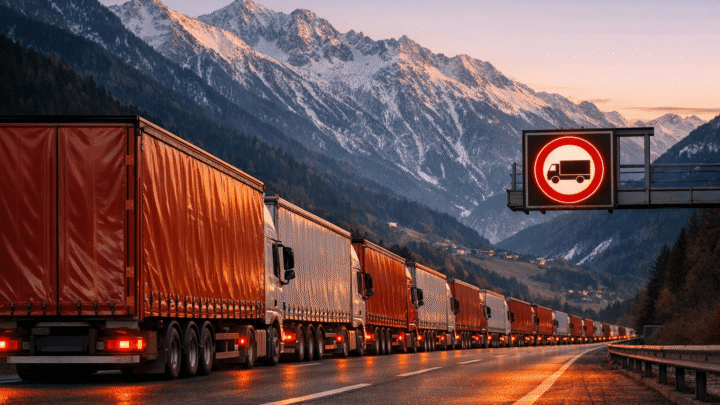
Germany truck driving ban 2026: Sunday rules, summer Saturday routes and fine amounts
Germany bans trucks over 7.5 tonnes on all roads every Sunday from 00:00 to 22:00, and on federal public holidays. An additional Saturday ban covers selected motorways from 07:00 to 20:00 every Saturday in July and August. Fines: €120 for the driver, €570 for the company. State-level holidays create route-specific traps that catch foreign carriers by surprise.

Germany bans trucks over 7.5 tonnes from its roads every Sunday and on federal public holidays, from midnight to 22:00. That is the baseline. On top of it, an additional Saturday ban shuts selected motorways to heavy freight from 07:00 to 20:00 every Saturday in July and August. Get caught running either ban and the driver pays €120 on the spot. The company that ordered the transport pays €570. No Flensburg points are issued, but the vehicle can be stopped and onward movement prohibited until the fine is settled.
The legal foundation is §30 paragraph 3 of the German Road Traffic Code (Straßenverkehrsordnung, StVO). It has been in force for decades and is enforced consistently by German police and the Federal Office for Logistics and Mobility (BALM). Foreign carriers are not exempt. The rules apply to any vehicle operating on German roads, regardless of where the truck is registered.
The Sunday and public holiday ban in full
Every Sunday without exception: trucks over 7.5 tonnes and all truck-trailer combinations cannot move between 00:00 and 22:00. The ban covers all roads, not just motorways. It applies to loaded and empty runs alike — an empty return journey is not exempt.
The same 00:00–22:00 window applies on nine federal public holidays that are observed across all German states: New Year’s Day (1 January), Good Friday (3 April 2026), Easter Monday (6 April 2026), Labour Day (1 May), Ascension Day (14 May 2026), Whit Monday (25 May 2026), German Unity Day (3 October), Christmas Day (25 December), and St. Stephen’s Day (26 December).
When a public holiday falls on a Sunday, the standard Sunday ban applies in full. There is no doubling-up of penalties, but the ban window is the same 00:00–22:00.
The summer Saturday ban: which roads, which hours
Every Saturday from 1 July to 31 August 2026, trucks over 7.5 tonnes and truck-trailer combinations cannot use a defined list of motorway sections between 07:00 and 20:00. This is the Ferienreiseverordnung — the holiday travel regulation. It was introduced to reduce congestion on the routes most affected by summer tourism traffic heading to and from Austria, Switzerland, and Italy.
The affected sections in 2026 include: A1 from Lübeck interchange to Puttgarden; A3 from Oberhausen interchange to Cologne-East interchange; A5 from Hattenbach interchange to Frankfurt/Main interchange; A6 from Mannheim interchange to Nuremberg interchange; A7 from Hamburg interchange to Flensburg interchange; A8 from Karlsruhe interchange to Salzburg; A9 from Munich interchange to Nuremberg interchange; A10 Berlin ring road (full circuit); A45 from Dortmund interchange to Aschaffenburg interchange; A61 from Mönchengladbach interchange to Ludwigshafen interchange.
The ban lifts at 20:00 on Saturday evening. Drivers can then move until midnight, when the Sunday ban starts. That two-hour window between 20:00 and 22:00 on Saturday nights is the only practical running time on those routes over a summer weekend.
State-level holidays that catch foreign operators off guard
Germany’s public holiday system is partly federal and partly administered at state level. A day that carries a truck ban in Bavaria may be a normal working day in Berlin. This is where foreign carriers coming from Poland, the Netherlands, or France tend to get stopped.
The most disruptive state-level holidays for transit planning are Corpus Christi (19 June 2026), which applies in Bavaria, Baden-Württemberg, Hesse, North Rhine-Westphalia, Rhineland-Palatinate, and Saarland but not in the northern states. All Saints’ Day (1 November 2026) applies in Bavaria, Baden-Württemberg, NRW, Rhineland-Palatinate, Saarland, and Saxony-Anhalt. Reformation Day (31 October 2026) applies in Brandenburg, Mecklenburg-Western Pomerania, Saxony, Saxony-Anhalt, and Thuringia.
A truck leaving the Netherlands for Bavaria on Corpus Christi crosses into Germany legally in the north, hits the ban the moment it enters Hesse. The driver has to know where the ban starts, not just that a holiday exists somewhere in Germany.
The Reformation Day and All Saints’ Day consecutive trap
31 October falls in Lower Saxony. 1 November falls in North Rhine-Westphalia. Back to back. A carrier that clears NRW on 31 October only to park in Lower Saxony overnight and continue on 1 November discovers that both days are banned in their respective states.
German authorities recognised this creates an impossible situation for north–south transit and established a coordination agreement. On both 31 October and 1 November, trucks are permitted to use a defined set of transit corridors from 06:00 to 22:00 rather than facing a full midnight-to-22:00 ban. The corridors are A1 from the Lotte/Osnabrück junction to the NRW-Lower Saxony border; A2 from the Bad Oeynhausen junction to the Lower Saxony–Saxony-Anhalt border; A30 from the Bad Bentheim border crossing to the Bad Oeynhausen junction; A31 and A33 within the relevant sections. The same window applies if either date falls on a Sunday.
Fines: what the German Bußgeldkatalog sets
The fine for violating the Sunday or public holiday ban is €120 for the driver. The company that commissioned the transport — the operator or dispatcher — pays €570. These figures come from the official German fine catalogue (Bußgeldkatalog, BKatV). No penalty points are added to the driver’s record, but German police can prohibit continued travel and hold the vehicle until the fine notice is issued. In repeat or serious cases, a temporary driving ban may follow.
For the summer Saturday ban, fines start at €25 and can rise depending on the specific offence and enforcement discretion. The Saturday ban is less uniformly enforced than the Sunday ban, but BALM and state police do run targeted controls on the affected motorway sections during peak summer weekends.
Exemptions that actually work
German law lists specific transport categories that are exempt from the Sunday and public holiday ban. The main ones that apply in practice for international freight: perishable food, including fresh milk, fresh meat, fresh fish, and fresh fruit and vegetables; combined transport operations where the truck is operating within 200 km of a rail loading or unloading terminal with a valid CIM or UIRR waybill, or within 150 km of a sea or inland port; newspaper and postal deliveries; emergency and humanitarian transport; and road recovery operations.
Permits to operate outside these categories can be applied for through the relevant local district authority. In practice, permits are issued only in genuine emergency cases where no alternative mode of transport is possible. Running a Friday load that missed its slot is not an emergency. Carriers who assume they can sort out a permit quickly tend to find the process takes longer than the ban itself.
The Saturday summer ban carries a similar exemption structure. Empty runs returning to base are permitted on summer Saturdays under certain conditions, but the vehicle must be genuinely running empty and the driver must be able to document that.
Truck speed limit on the Autobahn
Germany has no general speed limit for passenger cars on its motorways, which is a regular source of friction. Trucks over 3.5 tonnes are limited to 80 km/h on motorways. In practice this means a loaded truck doing 80 is routinely passed by cars doing 130 to 180 km/h. German police actively enforce the 80 km/h limit at fixed and mobile controls and through overhead gantry monitoring. Overloaded or oversized vehicles face additional restrictions and require advance permits for some routes.
Frequently asked questions
What time does the German Sunday truck ban start and end?
The Sunday and public holiday driving ban for trucks over 7.5 tonnes and all truck-trailer combinations starts at 00:00 (midnight) and ends at 22:00. It applies on every Sunday and on federal public holidays. The ban covers all roads across Germany, not just motorways, and applies to both loaded and empty journeys.
Which motorways are affected by the German summer Saturday truck ban in 2026?
The Ferienreiseverordnung Saturday ban, running every Saturday from 07:00 to 20:00 between 1 July and 31 August 2026, covers sections of A1, A3, A5, A6, A7, A8, A9, A10, A45, and A61. The affected sections are the high-volume summer holiday corridors running south toward Austria, Switzerland, and Italy. The complete list of sections is published annually by the Federal Office for Logistics and Mobility (BALM).
How much is the fine for violating the truck driving ban in Germany?
The driver faces a fine of €120 for breaching the Sunday or public holiday ban. The company that commissioned the transport pays €570. No penalty points are issued. Police can stop the vehicle and prohibit continued travel until the fine notice is processed. For the summer Saturday ban, fines start at €25.
Are state-level public holidays covered by the German truck ban?
Yes. The truck ban applies on state-level public holidays within the states where those days are observed. Corpus Christi (19 June 2026) bans trucks in Bavaria, Baden-Württemberg, Hesse, NRW, Rhineland-Palatinate, and Saarland, but not in Berlin or Hamburg. Carriers transiting through multiple states need to check the holiday calendar for each state on their route, not just the national list.
Is an empty truck run exempt from the German Sunday ban?
No. The Sunday and public holiday ban applies to both loaded and empty journeys where the vehicle is a truck over 7.5 tonnes or a truck-trailer combination used in connection with the carriage of goods. An empty return trip is not automatically exempt. The exemptions that apply are tied to specific goods categories — perishables, combined transport — not to whether the vehicle is loaded.
What is the Reformation Day and All Saints’ Day arrangement for truck transit in Germany?
31 October (Reformation Day in Lower Saxony) and 1 November (All Saints’ Day in NRW) create consecutive ban days on adjacent state routes. German authorities established a coordination arrangement that allows trucks to use the main transit corridors — A1, A2, A30, A31, A33 — from 06:00 to 22:00 on both days, rather than applying the full 00:00–22:00 ban window. The arrangement also applies if either date falls on a Sunday.