Most European truck fines happen by mistake — here is what they cost and what stops them
Most European truck fines are not the result of deliberate rule-breaking. FleetIntel's own questionnaire shows they come from human error: missed document expiry dates, miscounted cabotage runs, traffic bans nobody flagged, tachograph downloads forgotten. One France cabotage violation costs up to €15,000. FleetIntel costs €299 per month. The maths are not complicated.

Ask a fleet manager how their company got a fine and the honest answer is rarely “we were cutting corners.” It is more often something like this: a driver’s medical certificate expired quietly on a Tuesday. The dispatcher thought the tachograph download had been done. The manager planned a route through France on a public holiday that nobody had flagged. A cabotage run in the Netherlands went one operation over the legal limit because the counter reset date was in a spreadsheet nobody had open.
FleetIntel ran a questionnaire across European transport operators asking how their most recent significant fine actually occurred. The answers were consistent. Drivers did not set out to violate rules. Managers did not knowingly send trucks into restricted zones. The fines came from the gap between what the team knew and what the team needed to know — a gap that widens every year as EU enforcement expands, more countries coordinate checks, and more road rules change by date, by route, and by vehicle category.
The five human errors that generate most European truck fines
Expired documentation nobody checked. A driver’s medical certificate, CPC card, or tachograph calibration expires. It has been in the same drawer for two years. A ROADPOL inspector reads it in under thirty seconds at a rest area outside Cologne. The fine goes to the company, not just the driver, because the company was responsible for checking.
Tachograph data not downloaded within the required window. EU rules require driver card data downloaded every 28 days, vehicle unit data every 90 days. Miss the window and the gap in the archive looks like potential concealment to a BALM inspector — even if nothing was hidden. BALM now checks 56 days of vehicle unit data at roadside checks across Germany. A gap is treated as a probable violation until proven otherwise.
A traffic ban nobody mapped against the route. Germany’s Sunday ban runs from midnight to 22:00 every week. The summer Saturday ban closes ten specific motorway sections from 07:00 to 20:00 in July and August. France has a different ban calendar. Austria has seasonal restrictions that shift by two hours on May 1. A dispatcher who planned the route correctly last October may be working off memory that is six months out of date. One wrong departure time, one ban violated.
Cabotage counted incorrectly. Three operations in seven days, then a four-day cooling-off period. That is the EU rule. It sounds straightforward. In practice, a fleet running multiple drivers across France or the Netherlands is tracking three separate counters simultaneously, each starting from a different unloading date. One miscounted operation is a cabotage violation. In France, that starts at €15,000.
A country-specific rule the team did not know about. Poland’s SENT system requires pre-registration of certain goods movements. Finland’s new cabotage enforcement law entered force in May 2026 with fines up to €25,000 and vehicle clamping. Italy extended its smart tachograph requirements. Each country adds its own layer on top of EU baseline rules. The team cannot track them all from memory.

What these mistakes actually cost
The fine amounts are not small. They are not the kind of number that gets absorbed quietly into operating costs. They are the kind of number that gets discussed at board level.
| Country | Violation | Fine |
|---|---|---|
| France | Cabotage rule violations | Up to €15,000 + additional sanctions |
| France | Driver return not proven or improperly organised | Up to €4,000 |
| France | Weekly rest in the cabin or improperly organised rest | Up to €3,000 |
| Italy | Cabotage rule violations | €5,000–15,000 + vehicle impoundment |
| Italy | Improper smart tachograph | €866–3,464 + possible licence suspension |
| Germany | Tachograph / smart tachograph violations | €750–30,000 |
| Poland | Cabotage / SENT registration violations | ~€2,800 (PLN 12,000) |
| Netherlands | Driving under professional alcohol limit (0.2 g/l) | Criminal proceedings |
| Finland | Systematic illegal cabotage | Up to €25,000 + vehicle clamping |
FleetIntel costs €299 per month for fleets of up to 100 trucks. One avoided France cabotage violation covers 50 months of the subscription. One avoided German tachograph violation at the upper end covers 100 months. The arithmetic is not subtle.
EU enforcement is accelerating, not stabilising
The environment is not getting easier to navigate. It is getting more systematically enforced.
ROADPOL, the European road policing network, runs three coordinated Truck and Bus enforcement operations per year. The second of 2026 ran in the week of 4–10 May, with simultaneous inspections across all EU member states plus Switzerland, Serbia, and Turkey. The February 2026 operation on the E40 motorway in Belgium found violations in 97 of 168 vehicles checked — a detection rate of 58%. That is not a random sample of cheaters. That is more than half of the trucks on a normal transit motorway.
Cross-border fine collection means the fine follows the truck home. EU Directive 2015/413 requires member states to cooperate on collecting road safety penalties across eight violation categories. A fine issued in France or Germany during a ROADPOL week can be pursued by debt collection in Lithuania, Poland, or Romania. Ignoring a foreign EU fine is not an option — it accumulates administrative costs until it is settled.
From 1 July 2026, the tachograph and driving-time rules that have applied to HGVs will extend to light commercial vehicles between 2.5 and 3.5 tonnes used for international transport or cabotage for hire or reward. Fleets running vans on cross-border routes who have not installed G2V2 tachographs are now operating against a deadline that has already passed. The November 2026 ROADPOL operation will be the first to formally include those vehicles in its enforcement scope.
The tool problem: more systems do not mean fewer fines
The standard industry response to compliance risk is to add another system. A tachograph download tool here. A traffic ban calendar there. A separate portal for checking driving time logs. A spreadsheet for document expiry dates. A messaging thread where someone sometimes posts alerts about country-specific restrictions.
That is not a compliance infrastructure. That is a collection of partially overlapping information sources that requires a dispatcher to mentally synthesise across all of them — correctly, every time — while also managing live dispatch, driver communication, and customer deliveries.
Managing multiple disconnected systems creates administrative burdens and increases the risk of legal fines. The problem is not that fleet managers lack information. It is that the information is not where the decisions get made.
Decisions in a dispatch operation get made on the route map. The vehicle is there. The destination is there. The planned path is there. That is where the enforcement intelligence needs to be — not in a separate tab, not in a weekly email digest, not in a policy document that was last updated in 2024.
What FleetIntel adds to the map your team already uses
FleetIntel works as a Chrome extension that adds a live enforcement intelligence layer on top of the TMS map your team is already using. No IT integration project. No separate login. No migration. It works with LocTracker, Locator, FleetHand, and Fleetmaster today.
Here is what appears on the map, and what each element actually means for your operation.
Control spots — Locations where trucks have historically been stopped more often by police and transport authorities. The marker colour lets a dispatcher assess a location at a glance while planning the route. The question changes from “is there a risk somewhere on this route” to “I can see exactly where the historically active locations are and route accordingly.”
Control probability — A number on each marker showing the likelihood the location is active right now. The system updates every 30 minutes, factoring in time of day, day of week, historical reports, and active ROADPOL campaign dates. A control spot with a high historical risk score but low current probability looks different from one that is showing elevated probability at 14:00 on a Tuesday in May. Your dispatcher sees the difference.
Risk score — A 1–10 historical activity indicator. A location might show low current probability at 09:00 but carry a risk score of 8 because it has been consistently active over two years of reports. That matters for route planning the day before a run, not just the hour before.
Latest alerts — Real-time reports on active controls, roadworks, restrictions, strikes, and incidents on route. Not a static traffic layer. Actual dispatched information: a control is running at a specific location now, a strike has been called at a border crossing, a section of motorway is closed. This is the alert that reaches your dispatcher before it reaches your driver.
How the data is collected
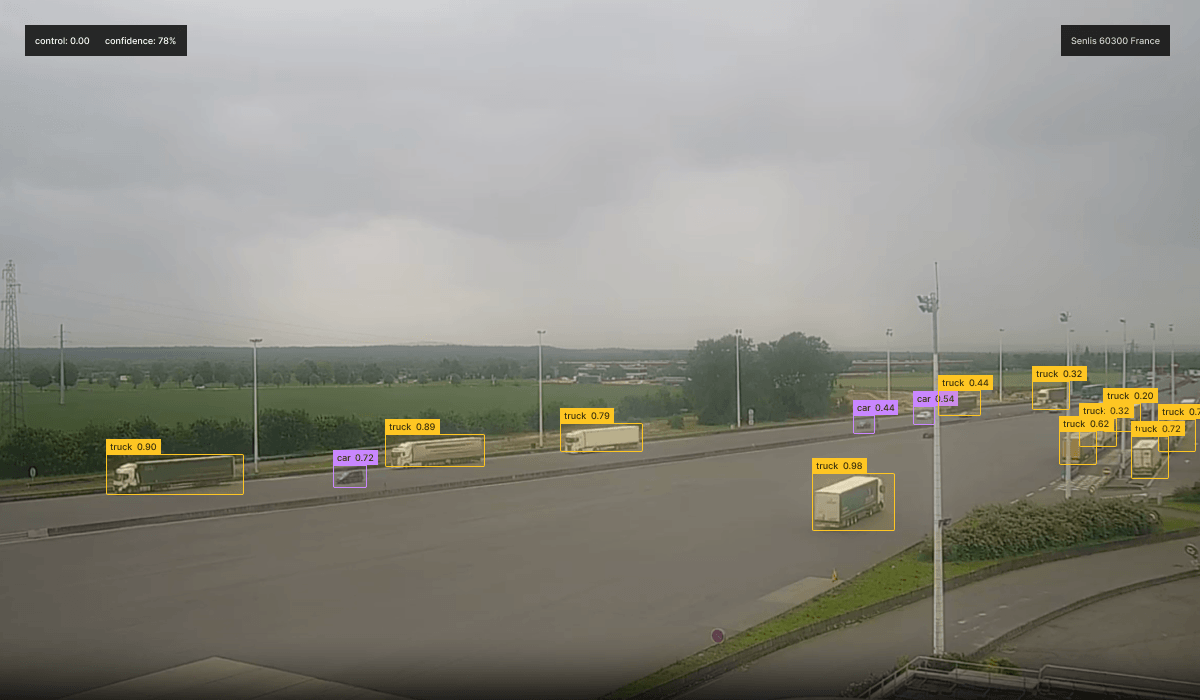
FleetIntel data comes from multiple simultaneous sources: reports from dispatchers and drivers on the platform, closed transport Telegram channels monitored for relevant alerts, Waze signals cross-referenced against route locations, and a computer-vision system monitoring public cameras in key enforcement areas. When multiple independent sources point to the same location at the same time, the confidence score rises. What appears on your map is a triangulated signal, not a single unverified report.
The 14-day question
FleetIntel offers a 14-day free trial — no card required. The relevant question is not whether you can afford €299 per month. The relevant question is whether your team, on its current tools, can reliably avoid the kind of mistakes that generate €3,000, €4,000, or €15,000 fines. If the answer involves any uncertainty at all, the trial costs nothing to find out.
ROADPOL’s May 2026 operation is running this week. The LCV tachograph deadline is 1 July 2026. Cross-border enforcement is already operational across EU member states. The window to operate without route-level enforcement intelligence is not open indefinitely.
Start your 14-day free trial — no card required →
Frequently asked questions
Does FleetIntel require IT integration with our transport management system?
No. FleetIntel works as a Chrome extension and adds a risk intelligence layer on top of supported TMS maps — LocTracker, Locator, FleetHand, and Fleetmaster. It is not a separate IT integration project and requires no involvement from your IT team to deploy.
How is control probability different from a static control spot map?
Static maps show where controls have happened. Control probability shows whether a specific location is likely to be active right now, updated every 30 minutes based on time of day, day of week, historical patterns, and live ROADPOL campaign activity. A location that has been active in the past may not be active today; one that has not appeared before might be elevated based on current signals.
Does FleetIntel guarantee we will avoid all fines?
No. FleetIntel does not remove the operator’s responsibility for following road rules and maintaining correct documentation. The extension helps your team identify risky locations, see live alerts, and make better-informed decisions faster — before problems reach the driver. Responsibility for compliance remains with the operator.
How much does FleetIntel cost after the trial?
€299 per month for fleets of up to 100 trucks. For fleets of 101–500 trucks, the price is €3 per truck per month. For more than 500 trucks, contact FleetIntel for a custom offer. The subscription covers all team members — pricing is calculated by truck count, not by number of users or computers.
What happens to enforcement rules from July 2026?
From 1 July 2026, EU tachograph and driving-time rules extend to light commercial vehicles between 2.5 and 3.5 tonnes used for international goods transport or cabotage for hire or reward. These vehicles will need to carry G2V2 second-generation smart tachographs and will be subject to the same driving and rest-time enforcement that applies to HGVs. The November 2026 ROADPOL Truck and Bus operation will be the first enforcement week in which those vehicles are formally in scope.